8-Point Pull Request Review Checklist for 2026
A practical pull request review checklist with 8 ordered checks, from tests to security to merge readiness. Copy-ready templates included.
In this article
- 1. Clear Pull Request Description
- What reviewers actually read
- When an agent opened the pull request
- 2. Design Conformance Check
- How to run it in ten minutes
- 3. Tests and Continuous Integration Status
- Ask for the test that fails
- 4. Change Size and Scope Review
- Split by what changes, not by file count
- 5. Security and Secrets Check
- 6. Error Handling and Edge Cases
- Three questions that find most of it
- 7. Documentation and Comments Update
- What belongs in the diff
- 8. Preview and UI Verification
- Write annotations something can act on
- What each review check looks for and who should run it
- Turn the Checklist Into a Habit Before Your Next Merge
A pull request lands on a Tuesday. CI is green, the description says "fix settings", and a teammate approves in four minutes. By Thursday the settings page saves an empty timezone for every new account, and rolling it back takes an afternoon.
That review wasn't lazy. It was unordered. The reviewer opened the diff, read the file they knew best, and ran out of attention before reaching the part that mattered.
Most review misses are boring. A missing test. An unhandled timeout. A token pasted into a config file. A confirmation step the design asked for and the code skipped. None of that needs deep expertise to catch. It needs a fixed order, so the checks that catch expensive failures happen before attention drains.
That's what this pull request review checklist is. Eight checks, ordered by what breaks first and costs most to fix later. Each one has a copy-ready template you can paste into your repository today, plus notes on what changes when an agent wrote the code. Work top to bottom. Stop when you hit something that needs fixing.
1. Clear Pull Request Description
A description that says "fix settings" costs the reviewer ten minutes of reverse engineering and costs the author nothing. That trade is backwards. GitHub's guide to optimizing pull request workflows and practices puts the scope test plainly: keep the change understandable in one sitting, and use the description to explain what changed, why it changed, the issues or design documents behind it, the risks, any rollback or migration concerns, and the exact steps to validate it.
A good one reads like a handover note. "Adds rate limiting to login. Card #42, design linked. Test by sending 10 login requests inside a minute and watching for 429s on the last three. Risk is shared cache. Rollback is one config flag."
Copy this template: Summary in two sentences. Why, with the card and design link. How to test, numbered steps. Risk and rollback in one line.
What reviewers actually read
Reviewers read the summary and the test steps, then skim the diff. Put those first and their attention lands on code. Bury the intent under commit messages and they'll guess at intent, which is where wrong approvals come from.
When an agent opened the pull request
Agent-written changes need more context, not less. A study of GitHub pull requests found 45.1% of merged agentic pull requests needed reviewer revisions, with no significant merge-time advantage over human-authored work, at a median of 1.23 hours versus 1.04 hours (empirical study of agentic pull requests). Faster code generation isn't faster review.
So require an evidence line from the agent: the plan it followed, the assumptions it made, the edge cases it knows it skipped. Three sentences saves a round trip.
2. Design Conformance Check
Checklists in code review aren't a modern invention. Michael Fagan's inspection method at IBM used structured preparation, defined roles and defect-focused checklists. NASA's summary of Fagan's controlled IBM experiments reported that inspections detected 82% of development-cycle errors before unit testing, and inspected software contained 38% fewer errors from unit testing through seven months of system testing (NASA report on Fagan's inspection experiments). Those were 1970s inspections, not GitHub merges, but the mechanism holds. A checklist applied at a fixed checkpoint before merge catches errors the code doesn't advertise.
Design conformance is the check often skipped. It asks one question. Does this diff do what the approved design said, no more and no less?
Say the design for a settings page says changing the timezone needs a confirmation step because it reschedules jobs. The diff ships the dropdown without it. Tests pass, the page works, the design is broken.
How to run it in ten minutes
Read the design before the diff, not after. Write down the three or five testable requirements it states, then look for each one in the code and its tests.
When something is missing, two outcomes are valid. The code gets fixed, or the design gets updated with an approval recorded on the card. What isn't valid is merging the difference and leaving the next reader to guess which document is true.
Loupe runs this check with a second agent against the approved design before a human opens the preview, and fix rounds continue until it passes. That moves most design drift out of human review time. A technical design review checklist covers what the design itself needs before coding starts.
Copy this template: Design doc linked. Requirements checked, numbered. Missing or changed items listed with the approval reference.
3. Tests and Continuous Integration Status
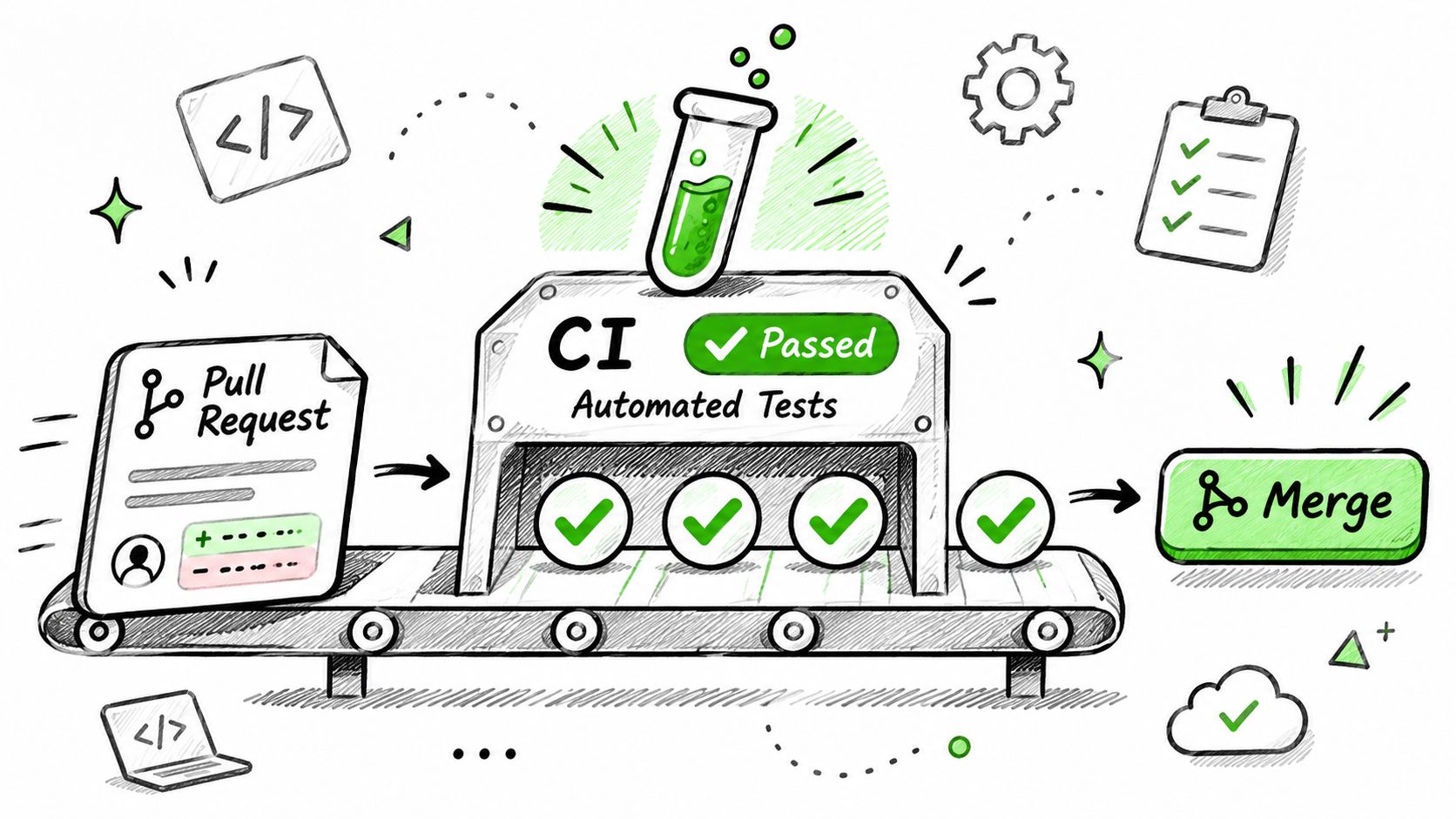
Green checks mean the change runs. They don't mean it's right, and they don't mean it's tested. Read the test files in the diff before you read anything else.
Branch protection that blocks merges until required checks pass is the cheapest review policy a team can write, and it doesn't depend on anyone remembering. Turn it on.
Recurring failures belong in the template, not in a reviewer's memory. An analysis of pull requests across 78 GitHub base projects, covering 20,142 developers, examined 9,421 pull requests and found each of eight identified technical issues appeared in 17.54% of requests on average, while only 7.76% of those requests succeeded in merging (study of technical issues in GitHub pull requests). The same problems keep arriving, so make them explicit prompts.
The pipeline is the first gate, not the last one.
Ask for the test that fails
A new test that passes on the first run proves very little. Ask whether it fails on the base branch.
For a bug fix, the test should reproduce the bug before the change lands. For a feature, the test name should describe the behavior in plain words, not the method it calls. And keep the suite fast enough that people run it locally, because a pipeline long enough to walk away from teaches everyone to merge on hope.
- Copy this template: Test
<name>fails on main, passes on this branch. CI build, lint, unit and integration all green. Known gaps listed or none.
4. Change Size and Scope Review
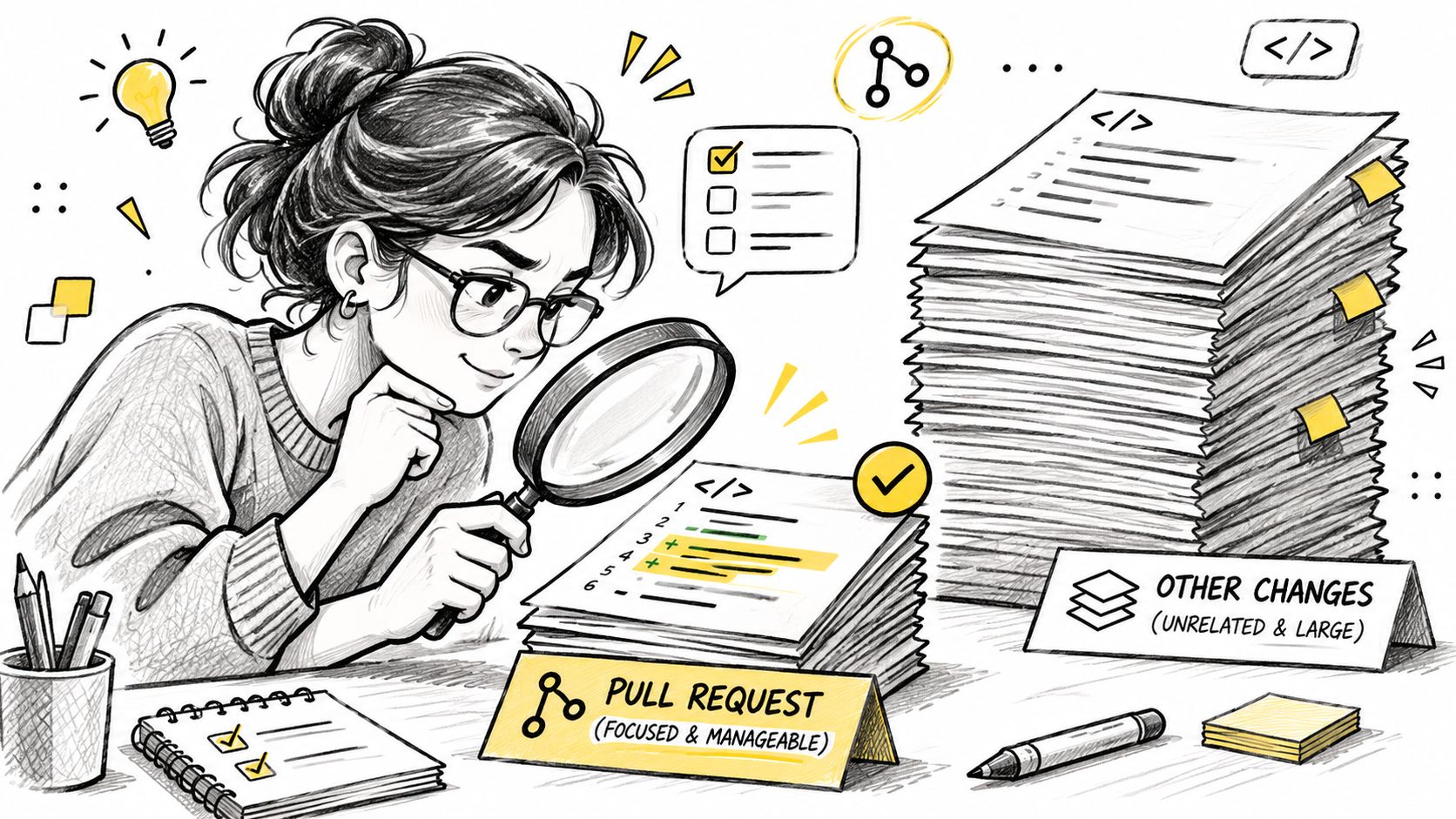
A 2,000-line pull request gets a shallower review than a 200-line one, whoever reviews it and however much they care. Microsoft research on code review at scale found review usefulness declines as the number of files grows, with the drop noticeable at around 20 or more changed files, and a median of about 24 hours from review request to all required sign-offs (Microsoft Research study of code review).
Small and focused looks nothing like large and mixed.
Split by what changes, not by file count
A team shipping a large settings feature splits it into three pull requests: the data model and migration, the API, then the UI. Each one reviews in under twenty minutes and rolls back on its own. Stacked pull requests do the same job when the later changes depend on the earlier ones.
Mixed diffs are the main problem. A rename plus a bug fix plus a dependency bump can't be reasoned about, because the reviewer can't tell which lines caused which behavior. Ask for the split before you start reading. It's a two-minute request that saves an hour.
Watch two numbers instead of guessing whether size is hurting you: fix rounds per pull request and hours to merge. Rising fix rounds on large diffs usually means reviewers are catching things that should have been caught by the author or by CI. Our guide to the pull request workflow covers where those splits belong in the pipeline.
- Copy this template: Files changed. One purpose per pull request, stated. Unrelated changes moved to another branch or noted as follow-up.
5. Security and Secrets Check
Security reviews don't behave like other reviews. A controlled experiment with 117 participants found security instructions helped reviewers, but adding a security checklist on top of those instructions didn't increase vulnerability detection (controlled security review experiment). The lesson isn't that checklists are useless. It's that telling someone to look for security issues does more than handing them a form.
So keep the human side to three questions and let tooling do the rest.
- Does this touch authentication or permissions? Any change to who can do what needs a second pair of eyes.
- Does it handle user input on a new path? Validation, encoding, parameterized queries.
- Does it add a credential? Keys belong in a secrets manager or environment variables, never in the diff.
Turn on secret scanning and dependency alerts so a committed token fails the pull request instead of shipping. Agents raise the stakes here, because they copy patterns from training data and from other repositories, and they don't know which token is live.
Our code review checklist covers the full set of pre-merge security gates if you need more than the three questions above. Start here, though, because a short list people apply beats a long one they skim.
Copy this template: Auth or permissions touched, yes or no. Input paths reviewed. Secrets confirmed in env or vault. Scans green.
6. Error Handling and Edge Cases
A checklist is a consistency device, not a defect detector, and it pays to be honest about that. In a distributed code-inspection experiment, checklist-based reviewers found 34.5% of defects against 42.8% for ad hoc reviewers, with no statistically significant difference in detection, review time or false positives between the two approaches (study comparing checklist-based and ad hoc code inspection). The value is the same checks happening every time, not a higher hit rate.
Use the check for the failures that hurt. Timeouts, empty inputs, partial writes, retries that run twice, and errors that vanish into a log line nobody reads.
A payment form that spins forever when the server times out is a review miss. A payment form that says "we couldn't reach the payment provider, your card was not charged" is the same code with a catch block and one message.
Three questions that find most of it
Ask what happens if this call fails, what happens if it fires twice, and what the user sees when it does. Ask whether the error carries enough context to debug from the log alone, without a reproduction.
Add a test for the most likely failure, not every possible one. One test that simulates a timeout catches more real incidents than five tests of improbable states, and the suite stays readable.
- Copy this template: Failure paths handled, listed. Retries idempotent. User-facing message checked. Test covers the most likely failure.
7. Documentation and Comments Update
Docs drift. Nothing fails when a setup guide goes stale, so nobody fixes it, and the next person loses an afternoon to an environment variable that moved six months ago.
Structured tooling helps more than nagging. An empirical study comparing review techniques inside one company found the tool-assisted technique generated about twice as many accepted comments as the alternative, and reported a negative relationship between comment density and review size, with correlations from -0.42 to -0.33 (study of tool-assisted code review). Reviewers working inside a review tool leave better findings than reviewers working in a chat thread.
The practical takeaway is to count accepted findings, not comment volume. A review with three comments that all get fixed beats one with fifteen that get dismissed.
What belongs in the diff
A new Docker environment variable should ship with an updated Compose guide in the same pull request. A changed API response field should update the reference doc. A non-obvious workaround deserves a comment that explains why, not what, because the code already says what.
Put a docs checkbox in the template so the question gets asked once, at the right moment.
Copy this template: Docs updated or not needed, say which file. Config and env changes documented. Non-obvious decisions commented with the reason.
8. Preview and UI Verification
Most of what ships broken is visible in ten seconds on a real screen. Tests can't see a button overlapping text at 375 pixels wide, and neither can a diff.
Open the preview deployment and walk the flow a user takes, not a single screen. Check the common widths, the empty state, the error state and the keyboard focus order. Squint at the copy, because placeholder text has a way of reaching production.
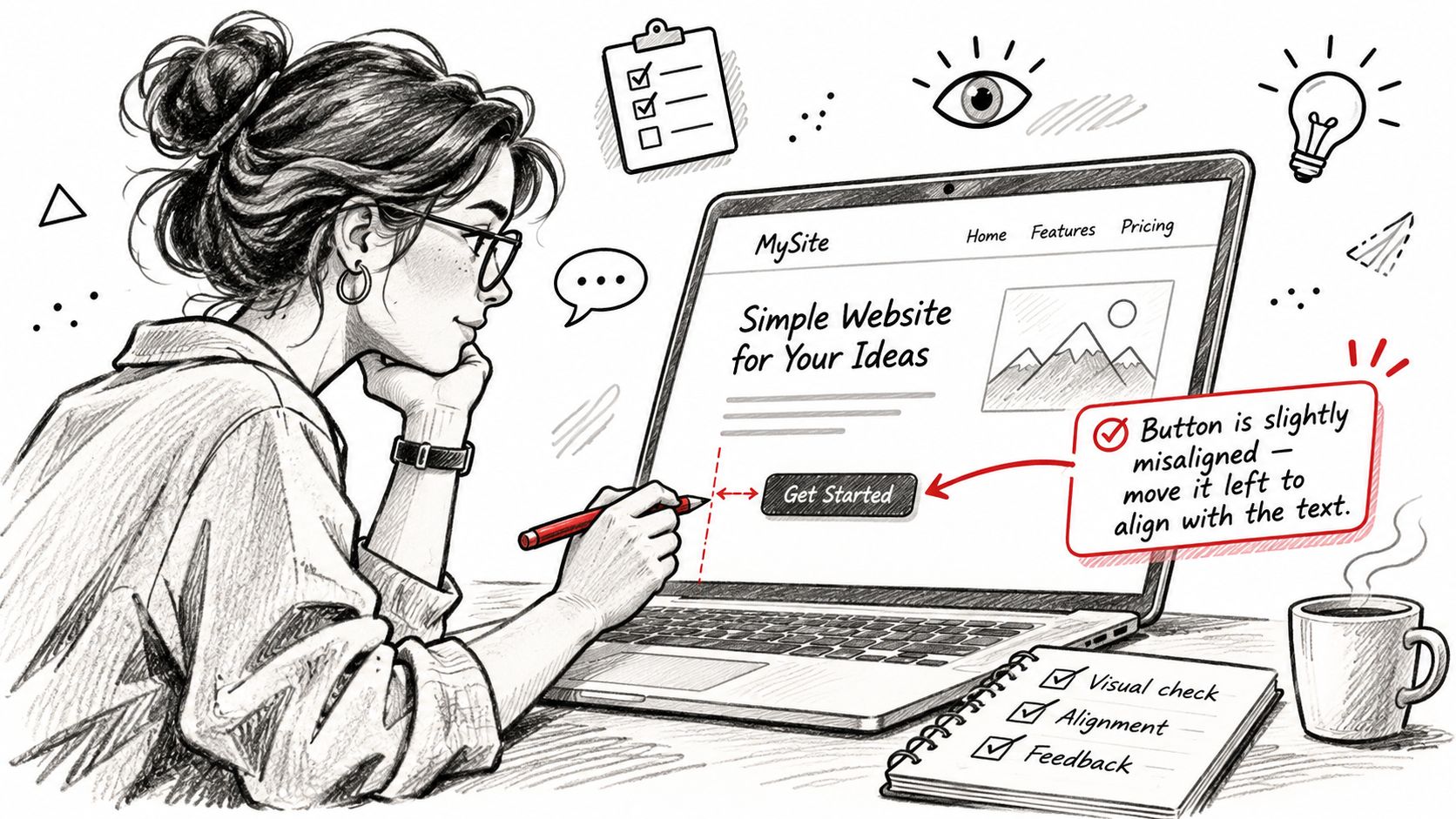
In Loupe's live review stage, you annotate UI elements directly on the preview and the notes save back to the card, so the fix request carries the screenshot and the location without a separate message.
Write annotations something can act on
Vague notes get dismissed. An analysis of coding review agents across 4,335 pull requests over ten months found 26.2% of automated comments were marked "Won't Fix" or "Closed" (study of review agents on pull requests). Human notes die the same way when they say "spacing feels off" without a screen or a value.
A reviewer marking the exact button that overlaps text on the mobile preview, with the width noted, gets a fix in one round. "Looks weird on mobile" gets a reply asking what weird means.
- Copy this template: Preview URL. Screens and widths checked. Flow walked end to end. Notes attached to the elements they describe.
What each review check looks for and who should run it
| Item | Key Question | Who Checks | Can Be Automated |
|---|---|---|---|
| Clear Pull Request Description | Does it explain the change, purpose, testing, and related links? | Author and reviewers | Partially, with a template |
| Design Conformance Check | Does the code match the approved design? | Reviewer or second agent | Partially, with an agent-assisted check |
| Tests and Continuous Integration Status | Do tests pass, and is new behavior covered? | CI and reviewer | Yes, for running tests and reporting status |
| Change Size and Scope Review | Is the change focused and manageable? | Reviewer | Partially |
| Security and Secrets Check | Are there exposed secrets or security risks? | Reviewer and security tools | Partially, with scanning tools |
| Error Handling and Edge Cases | Does the code handle failures and unexpected inputs? | Reviewer and test suite | Partially |
| Documentation and Comments Update | Do docs and comments reflect the change? | Author and reviewer | Partially |
| Preview and UI Verification | Does the change look and behave correctly in the preview? | Reviewer | Partially; preview deployment can be automated, visual review is manual |
Turn the Checklist Into a Habit Before Your Next Merge
A checklist only works if it's in front of the reviewer at the moment of review. Put it in .github/pull_request_template.md and keep it to eight short prompts. Anything longer becomes a form people tick without reading.
Then remove everything a machine can do better. Formatting, lint, type checks, unit tests, secret scanning and dependency alerts belong in CI, where they block a merge without a human remembering. The human list keeps what needs judgment: intent, design conformance, failure behavior, and what the page looks like to a person.
Measure the result instead of assuming it. Track fix rounds per pull request, hours to merge, reopened reviews and defects found after release. If a check never catches anything across a quarter, cut it. If one keeps catching the same class of bug, move it earlier, into the template, a linter or a test.
Loupe's workflow puts these checks in order by stage, and its analytics report cost per finished card, merge rate, fix rounds and hours to merge, so you can see whether the checklist is changing outcomes or just adding steps.
One more habit matters. Reviewers should start at item one every time, even on a tiny diff, because the cheap checks are the ones people skip when they're confident. Confidence is usually where the settings page breaks.
Add the checklist to your pull request template this week. Copy the eight templates above, delete the ones that don't apply to your stack, and run it on the next five pull requests before you decide whether to keep it.
Loupe orchestrates coding agents from product design through implementation and review, with a second agent checking every pull request against the approved design before a human sees it, and live review notes on the preview that save back to the card. The eight checks above are the human half of that loop, and the fix rounds that follow are the other half. Try it on your next feature at Loupe.