Design System Governance: Models, Roles and Rules
Design system governance in plain terms: pick a model, assign decision rights, set review gates and KPIs, and run the whole flow with or without agents.
In this article
- What Design System Governance Really Means
- The operating rules to publish
- Four Governance Models and How They Differ
- What the operating model looks like
- Roles and Decision Rights on One Page
- Keep ownership separate from advice
- The Contribution Workflow with Human Checkpoints
- Move the change through explicit gates
- Make accessibility evidence concrete
- Playbooks and Decision Templates You Can Copy
- Templates for recurring decisions
- Versioning is the compatibility contract
- Metrics and Audits That Show It's Working
- Pair activity with an outcome
- Audit the evidence, not just the totals
- Running Governance When Agents Do the Work
- Limit self-approval by risk
- Make approval reversible
- Your First 30 Days of Design System Governance
Adoption was the most cited challenge in Sparkbox's 2020 survey: 21 of the 56 respondents who answered the challenge question named it, according to this account of the Sparkbox survey. Among in-house respondents, 47% called their system immature, 28% neither mature nor immature, and 26% mature. Governance practices averaged 3.73, behind design and development culture at 4.57 and individual-contributor support at 4.26.
People can support a design system without knowing how to change it. Design system governance closes that gap through named owners, review checkpoints, and decisions recorded where the work happens. That remains true when agents draft, build, and review.
What Design System Governance Really Means
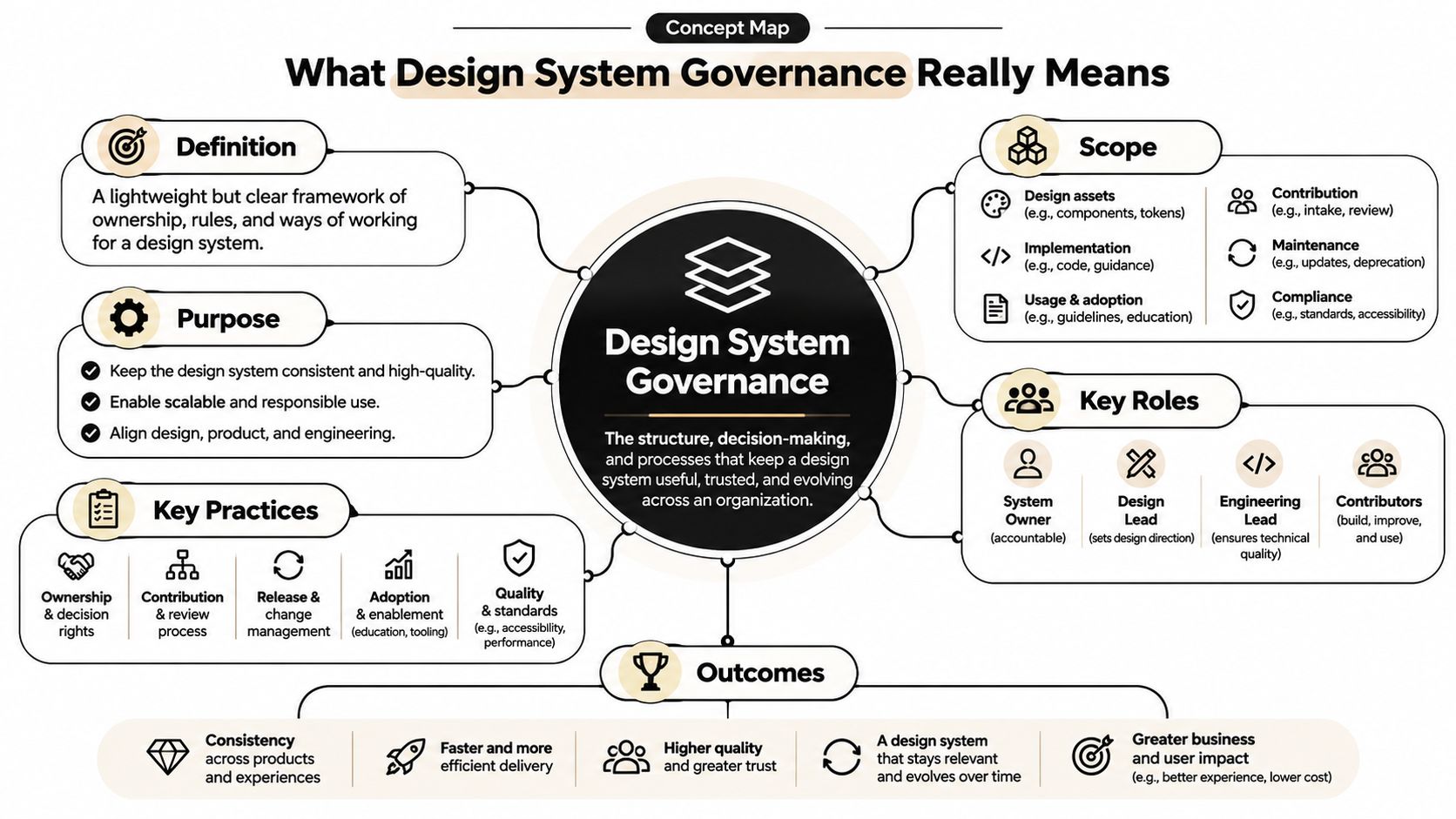
Design system governance defines who can change the system, what evidence a decision requires, and how approved changes are released or retired.
A document can state these rules, but a workflow puts them into practice. Put the approver, evidence, and release decision on the change card, where contributors and maintainers can find the record. Keep decisions attached to the work rather than scattered across chat.
A contribution process lets people propose changes. Governance also sets who can reject a proposal, how requests are prioritized, and who is responsible for migration. A design systems report may offer useful context, but the practical test is whether your team can answer those questions consistently.
Contribution is the entry point. Governance supplies the decision path and record. Without clear ownership, a growing stream of suggestions can leave teams unsure which request comes first or who has authority to decide.
Look for visible symptoms: teams maintain competing buttons, engineers change shared tokens inside product repositories, or unused components remain published because nobody can authorize removal. Trace each issue to an ownership or workflow gap before adding another contribution channel. More intake does not fix unclear decision rights.
The operating rules to publish
- Decision rights: Name who approves or rejects changes and who resolves disagreements.
- Intake: Classify requests and record which products or teams they serve.
- Quality gates: Specify the checks and evidence required before release.
- Change control: Set rules for versions, deprecation, and temporary exceptions.
Make the workflow auditable and reversible: record each decision, its owner, and the evidence used, and provide a clear route to reopen an approval when a later change exposes a problem. This gives human reviewers an explicit gate even when agents draft, build, or review work.
Ask a contributor and a maintainer separately: Who approves a new component, and what do they check? If the answers differ, clarify the approval path before expanding the contribution program. The rule should be easy to find on the change card.
Four Governance Models and How They Differ
| Model | Who decides | Who builds | Speed | Main risk | Best fit |
|---|---|---|---|---|---|
| Centralized | Core design system team | Core team only | Fast consistency, slow throughput | Shared-team bottleneck | Small organizations or one product suite |
| Federated | Product teams within their areas | Product teams | Fast local throughput | Token, spacing, and accessibility drift | Autonomous teams with shared foundations |
| Hybrid | Core owns tokens and primitives; domain owners handle the rest | Core team and reviewed contributors | Balanced | Growing review queue | Multiple consuming teams with contribution capacity |
| Open with review gates | Fixed panel or council | Contributors and maintainers | Deliberate | Panel becomes a wall or rubber stamp | Large organizations with a brief and fixed cadence |
Centralized governance gives consumers a clear destination. It fails when every correction waits behind core-team project work. Watch queue age and local forks rather than using team count alone to decide when to change.
Federated governance puts builders near the product problem. It needs shared token rules, accessibility checks, and a named tie-breaker. Without those controls, teams can use the same library name while shipping different behavior.
Hybrid governance protects shared foundations while letting product teams own domain patterns. Write the boundary explicitly: who owns the primitive, who owns the composition, and who reviews API changes. Otherwise, every decision returns to the core team.
Open contribution with review gates broadens who can propose and build. It doesn't remove approval authority. Publish a brief, review rubric, and release cadence so contributors can plan around them.
What the operating model looks like
The IBM Carbon governance case study describes separate processes for consuming, extending, and contributing, with a biweekly rotating pattern panel checking repeatable need, a narrow API, and WCAG 2.1 AA. It reports that clearer contribution guidance reduced estimated time to ship a pattern from one quarter to one week, while component forks fell 41% per quarter and upstream contributions tripled the following year.
An enterprise design-system case study describes standardized briefs, a three-person team reviewing fortnightly, and accepted work released monthly; by 2024, product teams supplied 30% of new components. That shows open contribution can coexist with centralized review.
I would use sustained product-team contribution as a trigger to reconsider pure centralization, not treat that share as a universal threshold. Count consuming teams, incoming changes, and available reviewers. Then write a switch rule: move toward hybrid ownership when product teams can build and support accepted components without weakening review or release discipline.
Roles and Decision Rights on One Page
| Decision | Decides | Consulted | Informed |
|---|---|---|---|
| New component | Design system lead | Design lead, accessibility specialist, engineering lead | Product teams |
| Token or spacing change | Design system lead | Engineering lead | All consumers |
| Backward-compatible addition | Maintainer | Design system lead | Product teams |
| Breaking API, prop, or token change | Council, with a named decision owner | Engineering lead, accessibility specialist, docs owner | All consumers |
| Deprecation and removal date | Council, with a named decision owner | Docs owner, affected product teams | All consumers |
| Local override or exception | Engineering lead, with design system lead agreement | Accessibility specialist | Council at next review |
| Documentation standard | Docs owner | Design system lead | Maintainers |
| Major version release | Design system lead after council review | Engineering lead | All consumers |
Use role names in the policy, then assign actual people on each card. Consulted doesn't mean responsible for approval. A reviewer can supply evidence without becoming another person whose silence blocks release.
Keep ownership separate from advice
Every model needs an owner who can say no. That person must be able to reject a duplicate component, require a narrower API, or defer work that lacks a consumer. Give the owner authority to prioritize maintenance alongside new requests.
Maintainers build, test, review, and release. Protect their capacity for this work. An approval path won't help if the people named in it have no time to examine the change.
For escalations, I would start with a small council, a fixed fortnightly slot, and a short agenda. Reserve it for breaking changes, deprecations, and unresolved cross-product trade-offs. Routine approvals should stay with the owner or maintainer.
Practical rule: A council can advise together, but a card still needs a named person who records the final call.
Rotate a reviewer seat so knowledge doesn't remain with a single maintainer. Attach the decision, date, rationale, and any conditions to the card. For exceptions, include an expiry and the person responsible for removing the override.
The common failure isn't an incomplete table. It's a table nobody uses because decisions happen in chat. When a thread changes the outcome, copy the final decision to the work item before anyone starts implementation.
The Contribution Workflow with Human Checkpoints
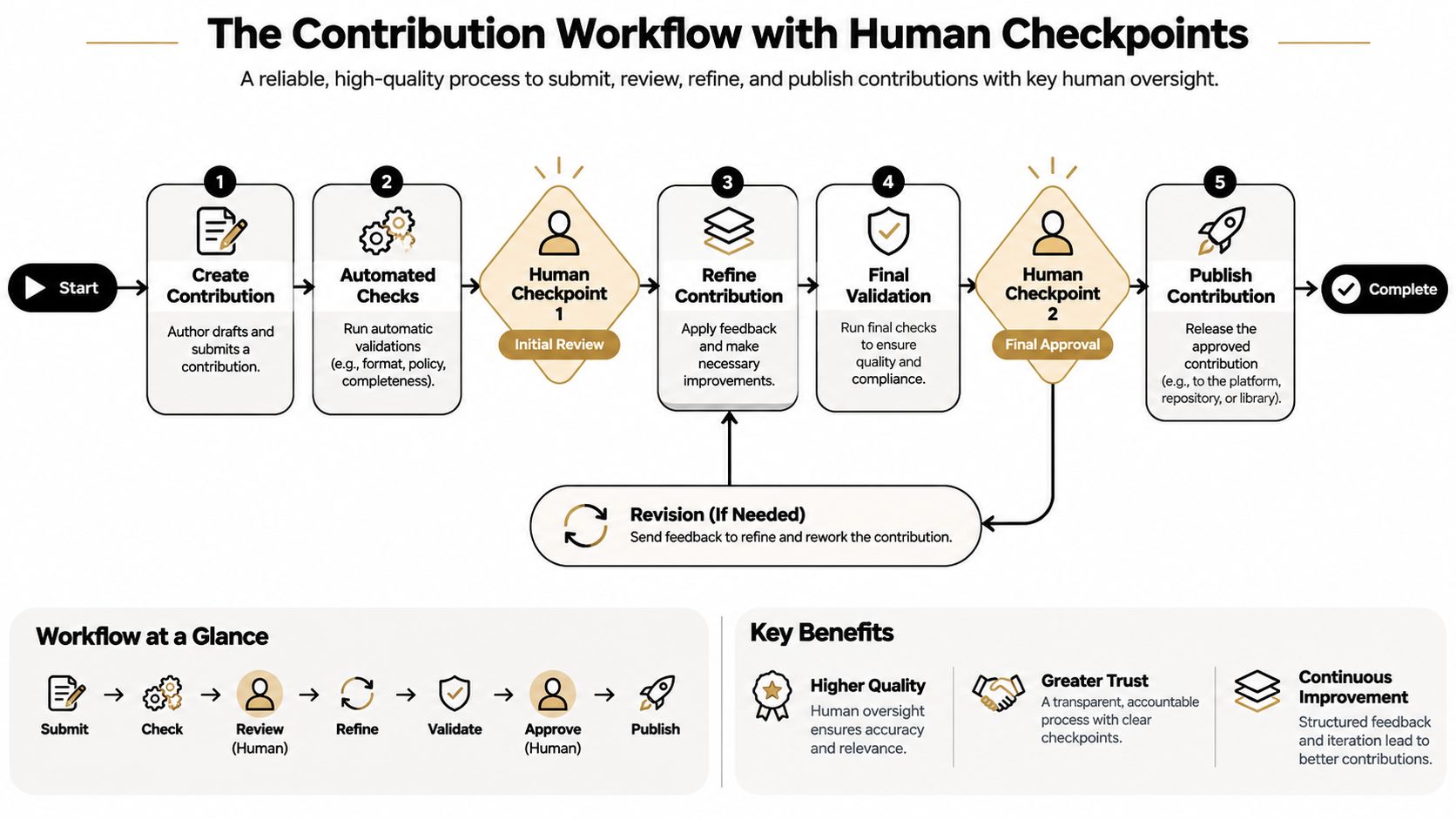
Treat a contribution as a controlled software change. The governance and versioning guide describes distinct contribution types and review responsibilities, with under 10 business days as a useful operating target for a complete component contribution. Use that as a planning target, not permission to skip checks.
Move the change through explicit gates
Type the intake card. The maintainer classifies it as a fix, enhancement, new component, or deprecation and attaches the problem, consumers, and proposed scope. Missing evidence returns to the contributor before review begins.
Run automated pre-checks. CI attaches token-lint results, accessibility scan output, and visual differences against the approved baseline; the maintainer confirms the checks ran against the proposed change. A failure stays attached to the card and returns to implementation.
Review the design. The design owner checks existing patterns, states, responsive behavior, and whether composition would solve the need without another component. They sign the design evidence or return a specific finding with an expected correction.
Review accessibility. The accessibility specialist signs keyboard behavior, ARIA semantics, focus handling, and the declared WCAG acceptance criteria, using automated checks plus manual device testing. A failed check returns to this gate with its finding attached and isn't waived for schedule.
Review engineering. The engineering reviewer signs API stability, tests, implementation feasibility, and design-code parity. An incompatible prop or unsupported state returns to the relevant design or implementation step before approval.
Review documentation. The docs owner checks installation, usage, supported states, limitations, and migration notes. If a consumer would need to ask the author how to use the change, the contributor fills that gap before proceeding.
Make the human release decision. The named approver checks the evidence and records release or rejection, including the version impact. An unresolved question blocks approval; rejection returns the card to the failing step, not the back of the intake queue.
Make accessibility evidence concrete
The account of public-sector accessibility governance describes USWDS meeting WCAG 2.0 AA and Section 508, testing with ANDI and axe-core, and prioritizing reported accessibility issues. It also describes VA.gov checking semantic markup and ARIA, running axe-core across every component variation, and manually testing a defined assistive-technology matrix on real devices.
Adopt the testing mechanics, but state your own acceptance standard clearly. Don't treat a clean automated scan as proof that keyboard and screen-reader behavior work.
For a narrow, low-risk fix, use automated checks and a qualified reviewer who verifies the affected areas. New components need the full design, accessibility, engineering, and documentation review. Keep visual feedback tied to evidence through a product design review process, rather than collecting approval in disconnected screenshots.
Playbooks and Decision Templates You Can Copy
Keep each template short enough to complete while working on the card. A template nobody fills in is worse than none because reviewers may mistake an empty form for evidence.
Templates for recurring decisions
- Contribution brief: Use before building a shared addition. Record the repeatable problem, evidence, existing alternatives, proposed API, accessibility notes, intended consumers, and contributor.
- Decision record: Use when choosing between meaningful alternatives. Record context, options, decision, rationale, owner, decision date, review date, and the linked work item.
- Deprecation notice: Use before withdrawing supported behavior. Include what is leaving, why, replacement, warning date, removal date, migration guide, and a codemod or automated check where feasible.
- Exception request: Use when a product must depart from a rule. Name the rule, reason, scope, risk, owner, expiry, and removal plan.
- Monthly review agenda: Use to prepare the operating review. List blocked contributions, proposed breaking changes, expiring exceptions, migration risks, and decisions that need an owner.
A review date matters. Without one, a decision made under an old constraint can become permanent policy. Reopen the record when that date arrives and either renew it with a reason or replace it.
Versioning is the compatibility contract
The governance and contribution models guide treats semantic versioning as change control: patches preserve the intended API while fixing defects, visual regressions, or accessibility issues; minor releases add backward-compatible components, tokens, or properties; major releases contain incompatible removals, renames, props, markup, or layout changes.
Classify the release by consumer impact, not by how small the code diff looks. A token rename can be a breaking change even when implementation takes little effort.
Write the migration path and removal horizon before approving a major release. Make CI run accessibility checks, visual regression, unit tests, documentation checks, and token lint before the release becomes eligible for sign-off. Keep the release record linked to the exact build that passed.
Metrics and Audits That Show It's Working
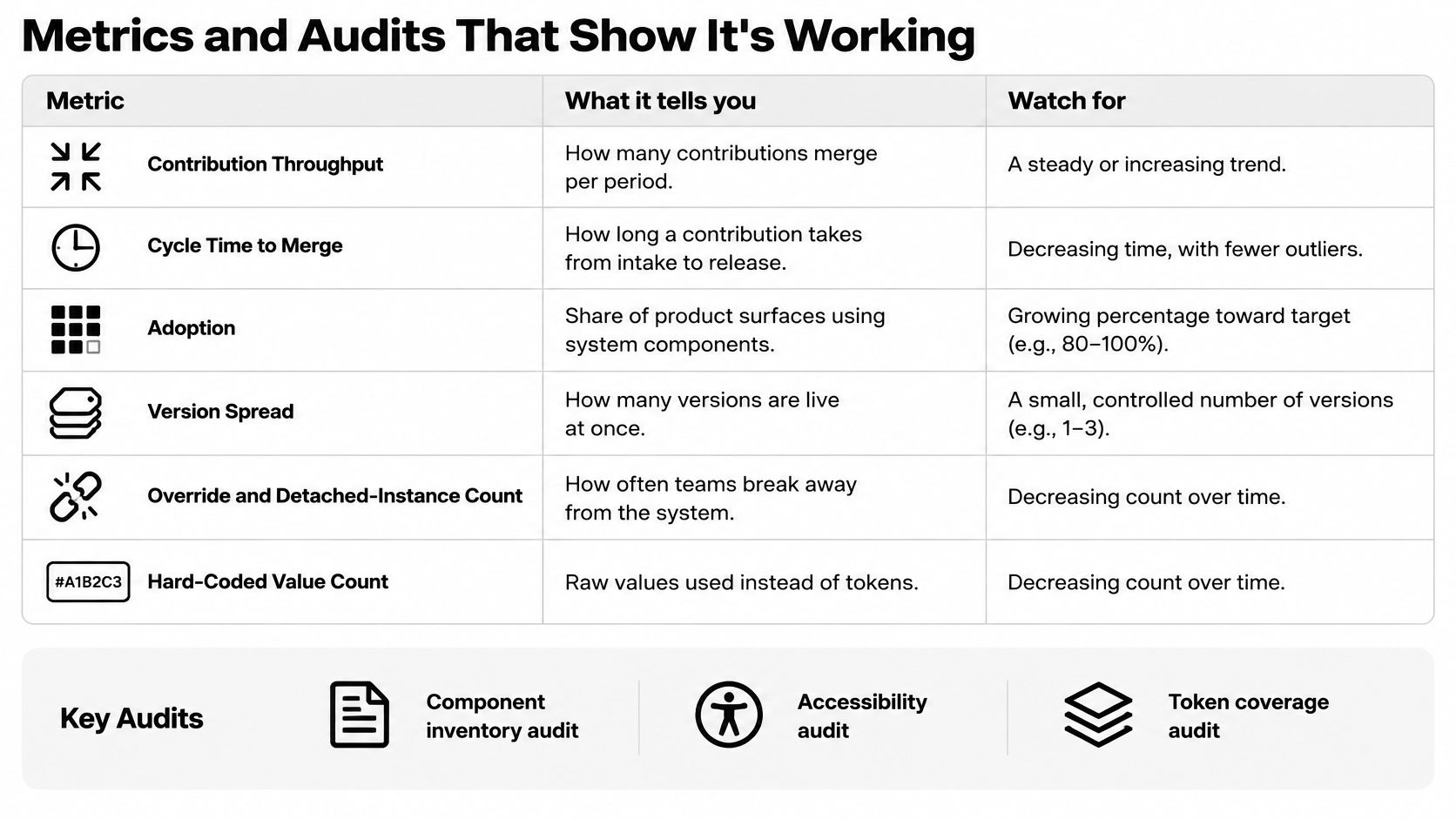
| Metric | What it tells you | Healthy target | Where to get it |
|---|---|---|---|
| Contribution throughput | Whether contribution is real | Steady flow without long dry spells | Merged cards by change type |
| Cycle time to merge | Contributor waiting and rework | Within the agreed contribution window | Card creation and merge dates |
| Adoption | Whether products use the system | Wide or full adoption across most teams | Consumer survey and repository imports |
| Version spread | Migration debt | Consumers remain within the supported version policy | Package manifests |
| Override and detached instances | Where abstractions fail | Falling over successive reviews | Design-tool and code audits |
| Hard-coded value count | Token coverage in code | Near zero, excluding documented exceptions | Token lint in CI |
| Documentation completeness | Whether consumers can self-serve | Every shipped component has usage, do and don't, and migration notes | Release checklist |
| Accessibility defects caught before release | Whether gates detect problems | Earlier detection, fewer escaped defects | Scans, manual tests, production reports |
| Consumer satisfaction | Whether governance helps | Stable or rising feedback | Short recurring product-team survey |
These are operating targets, not external benchmarks. Define denominators before publishing the dashboard. Adoption measured by repository imports isn't the same as adoption across product surfaces.
The 2026 Design Systems Report found 7% full adoption, 31% wide adoption, 38% moderate adoption, 22% minimal adoption, and 1% no adoption; it also found 69% encouraged open contribution, while more than two in five still gatekept contributions. The report says teams more commonly measured usage and coverage than time saved or improved consistency.
Pair activity with an outcome
Choose a usage measure and an outcome measure that answer the same question. For example, pair component adoption with the rework needed to deliver a consuming screen. More imports alone don't tell you whether teams finished useful work faster.
Keep merge time separate from release time. A merged component that consumers can't install yet hasn't completed the delivery path.
Audit the evidence, not just the totals
I would run a quarterly sample audit:
- Contribution records: Check recent changes for real signatures, attached findings, and approval after fixes.
- Consumer code: Scan hard-coded values and overrides, then separate approved exceptions from unmanaged drift.
- Version inventory: Flag applications outside the supported major-version window and assign migration owners.
- Accessibility: Sweep heavily used components with automated and manual tests, including their important states.
For agent-led work, use AI agent observability to connect execution evidence with the eventual result. A completed run isn't the same as an accepted contribution.
Keep the monthly review to a page with a small set of decision-driving numbers: flow, adoption, and escaped defects. Assign an action and owner whenever a measure worsens.
Running Governance When Agents Do the Work
| Governance element | Workflow mechanism | What it enforces |
|---|---|---|
| Decision rights | Named human checkpoint where the card pauses | An identifiable approver and recorded decision |
| Intake | Typed cards with stage and state | Different paths for fixes, enhancements, new components, and deprecations |
| Quality gates | Dual-agent review before human inspection | Evidence-based checks against the approved design |
| Evidence | Preview annotations saved to the card | UI feedback tied to the change |
| Change control | Undo approval and request downstream changes | Reversible decisions with preserved history |
| Metrics | Cost per finished card, merge rate, fix rounds, hours to merge | Cost and quality comparisons per card and model |
Agents don't need a separate governance constitution. They need the same authority boundaries expressed as workflow rules. States such as working, waiting, stuck, and needs you should tell the owner whether execution is progressing or a decision is missing.
Limit self-approval by risk
In our workflow, a design with no open question approves itself when published and moves the card forward. The workflow template determines which designs and card types are covered. A clean tech design can approve itself for every card type, including bug, tooling, and documentation cards.
That capability isn't a reason to auto-approve every change. No open question doesn't mean no risk. Keep automatic advancement for reversible, low-risk design decisions, and distinguish design-stage approval from authorization to publish a breaking release.
An agent can check whether implementation matches an approved API. It can't decide that affected product teams have accepted the cost of migrating away from that API. Keep breaking changes and deprecations on the human sign-off list.
An agent review is a pre-filter, not the human gate.
Make approval reversible
Undoing a design approval in our workflow returns the card to that design's column, stops its background workers, and requests changes on the later design. That gives the owner a concrete way to withdraw consent without pretending the earlier decision never happened.
Use this deliberately when feedback changes the approved scope. Stop downstream work, attach the new finding, and revise the controlling design before implementation continues. Don't ask an agent to patch around a decision you no longer support.
An AI agent governance framework should make those boundaries visible: what can advance automatically, what must pause, and what an owner can undo. Compare models on accepted work and fix rounds, not just the speed of the first draft.
Your First 30 Days of Design System Governance
Don't start with a long handbook. Use the first month to put the operating rules on real changes.
- Week 1, publish ownership: Name the owner and complete the decision-rights table. Put the approver and decision date on every active change.
- Week 2, make intake usable: Publish the contribution brief and classify work as fixes, enhancements, new components, or deprecations. Add the review gates as visible card requirements.
- Week 3, inspect actual work: Turn on cycle time, version spread, and override tracking. Sample recent contributions to check that reviewers signed the gates rather than moving cards without evidence.
- Week 4, complete the loop: Hold a short operating review and ship an accepted component through the planned monthly release. Publish what was accepted, deferred, and rejected, with an owner for follow-up.
Our workflow has six stages: product design, tech design, implementation, agent review, live review, and done. A second agent reviews each design and each pull request against the approved design, returning failures for fixes before human review. Attach governance evidence to that existing flow rather than creating a parallel approval board.
Adoption remains the test. A policy that never reaches the card won't change how teams contribute or consume components.
Before Friday, choose the model, name the owner who can say no, and publish the changes that always wait for a human: breaking API or prop changes and deprecations.
Loupe brings product design, technical design, implementation, and review onto a shared board with explicit human checkpoints and traceable feedback. Visit Loupe to explore a workflow where agents do the work while you keep control of approval and revision.