AI Agent Governance Framework: A Simple Guide for 2026
Learn how to build an AI agent governance framework with checkpoints, audit logs, model choices and compliance steps. Simple, practical and easy to start.
In this article
- Why Agent Governance Cannot Wait
- The Core Parts of a Working Framework
- Core parts of an agent governance framework
- Where Human Checkpoints Belong
- Place gates around consequential decisions
- Limiting What Each Agent Can Touch
- Make permission temporary and revocable
- Keeping Records You Can Audit
- Keep a connected evidence trail
- Choosing Models and Tracking Their Results
- Metrics to track for each agent workflow
- Compliance Dates and Standards to Track
- Key AI governance dates and standards
- Start With One Workflow
- A small rollout you can inspect
Only 13% of surveyed IT application leaders strongly agreed that their organizations had the right governance structures to manage AI agents in 2025, according to Gartner's survey of 360 leaders across North America, Europe and Asia-Pacific. The practical gap isn't another policy document. It's knowing what agents can do, being able to withdraw that permission, and keeping records that prove what happened.
Why Agent Governance Cannot Wait
In 2025, just 12% of 603 business and technology leaders worldwide said their risk and governance controls were fully in place for agentic AI, according to Harvard Business Review Analytic Services, reported by Fortune. An AI agent is software that can take steps toward a goal, such as writing code, opening pull requests, or calling other tools.
A basic chatbot answers a question. An agent can do work after receiving an instruction. Giving it broad access without controls is like giving a new hire a company card with no spending limit and no purchase records.
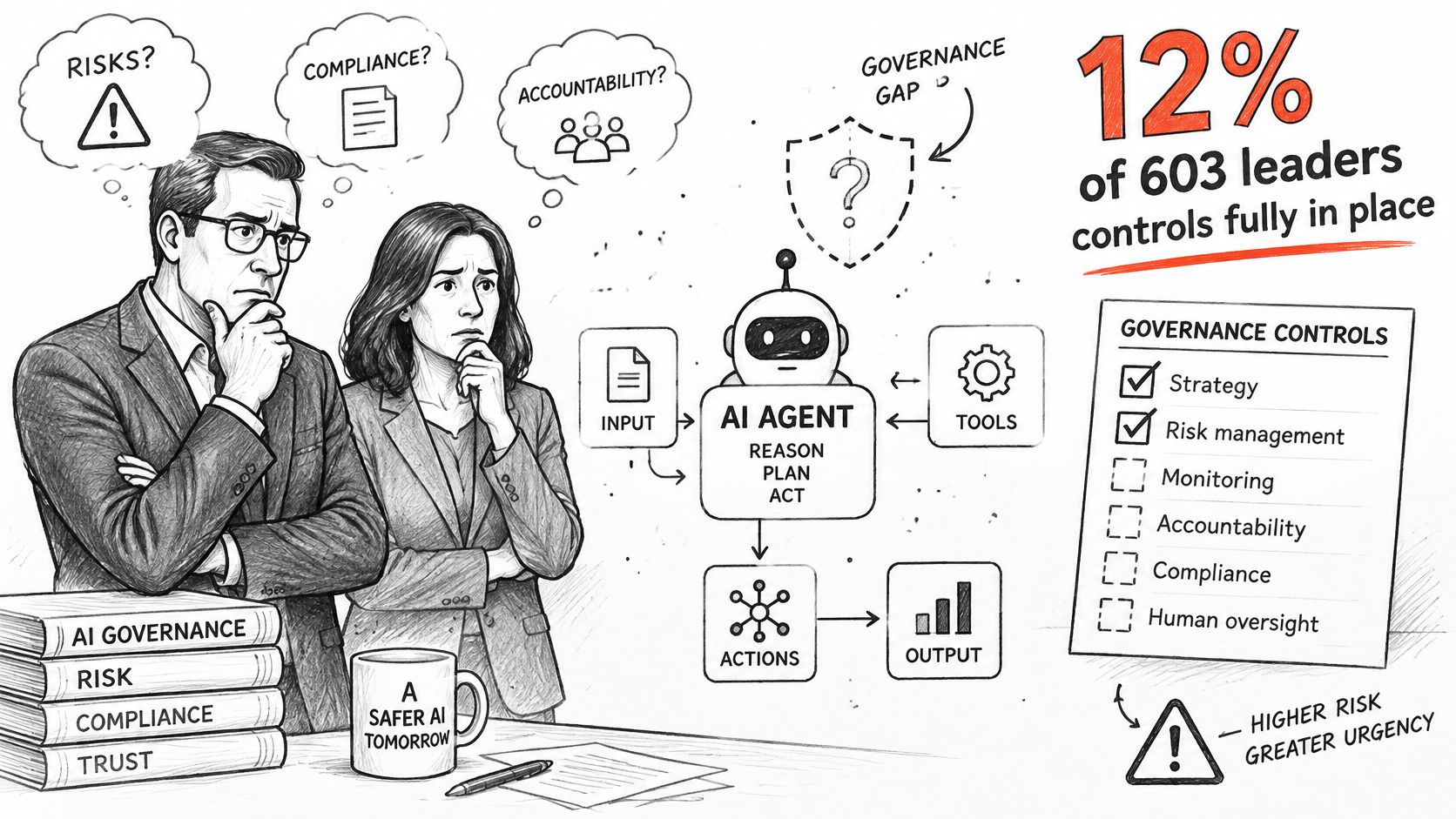
Governance matters for practical reasons:
- Mistakes can spread. An agent may reuse a wrong assumption across several files before a reviewer sees it.
- Tools change real systems. Repository access, deployment credentials, and database tools turn a poor answer into an operational problem.
- Responsibility can become unclear. Without a review trail, teams may struggle to identify who authorized a change.
An AI agent governance framework is a set of rules, roles, checkpoints, and records that defines what an agent may do, who checks its work, and how you prove what happened.
A human approval button isn't enough if nobody can explain what the agent was allowed to do before reaching it.
Ask your team: Who owns each agent? What can each agent touch? Can we show what it did last week? Any unclear answer gives you a useful place to start.
The Core Parts of a Working Framework
A safe building has rules, locks, alarms, and cameras. Each serves a different purpose. Written rules don't lock doors, and cameras don't prevent entry.
Agent governance needs the same separation. A policy describes acceptable behavior, permissions enforce boundaries, monitoring detects problems, and records support investigation.
The NIST AI Risk Management Framework, published in January 2023, treats governance as continuous organizational practice rather than a one-time certificate. Its GOVERN function supports testing, incident identification, and information sharing, alongside the MAP, MEASURE, and MANAGE functions.
Core parts of an agent governance framework
| Part | Question it answers | Simple example |
|---|---|---|
| Ownership | Who is responsible for each agent and workflow? | One named owner per workflow |
| Identity | Which agent did this action? | A separate account for each agent |
| Permissions | What can the agent read or change? | Reviewer agents read only; coding agents write to a branch only |
| Checkpoints | When must a person approve before work continues? | Design approval before any code is written |
| Audit records | What happened, in what order, and who approved it? | Logged runs, tool calls, review notes, and overrides |
| Monitoring and stop rules | When should the agent pause or stop? | Pause after repeated failed design reviews |
These parts need to work together. Suppose a coding agent repeatedly fails design review. Monitoring should detect that pattern, a stop rule should pause execution, and the named owner should decide whether to revise the task or change the setup.
Don't treat an agent's instructions as proof that these controls exist. Check the actual account permissions, workflow settings, and records from a completed task.
Mark each part as working, missing, or untested. Anything with no owner or no written rule needs attention before you expand autonomous work.
Where Human Checkpoints Belong
A checkpoint is a point where an agent must stop and wait for a person. Think of a pilot's checklist before takeoff: fixed steps, no skipped steps.
For high-risk systems, Article 14 of the EU AI Act treats human oversight as a working control. Assigned people must be able to understand capabilities and limits, notice unusual performance, interpret or override outputs, and interrupt operation safely. Oversight must match the system's risk, autonomy, and context.
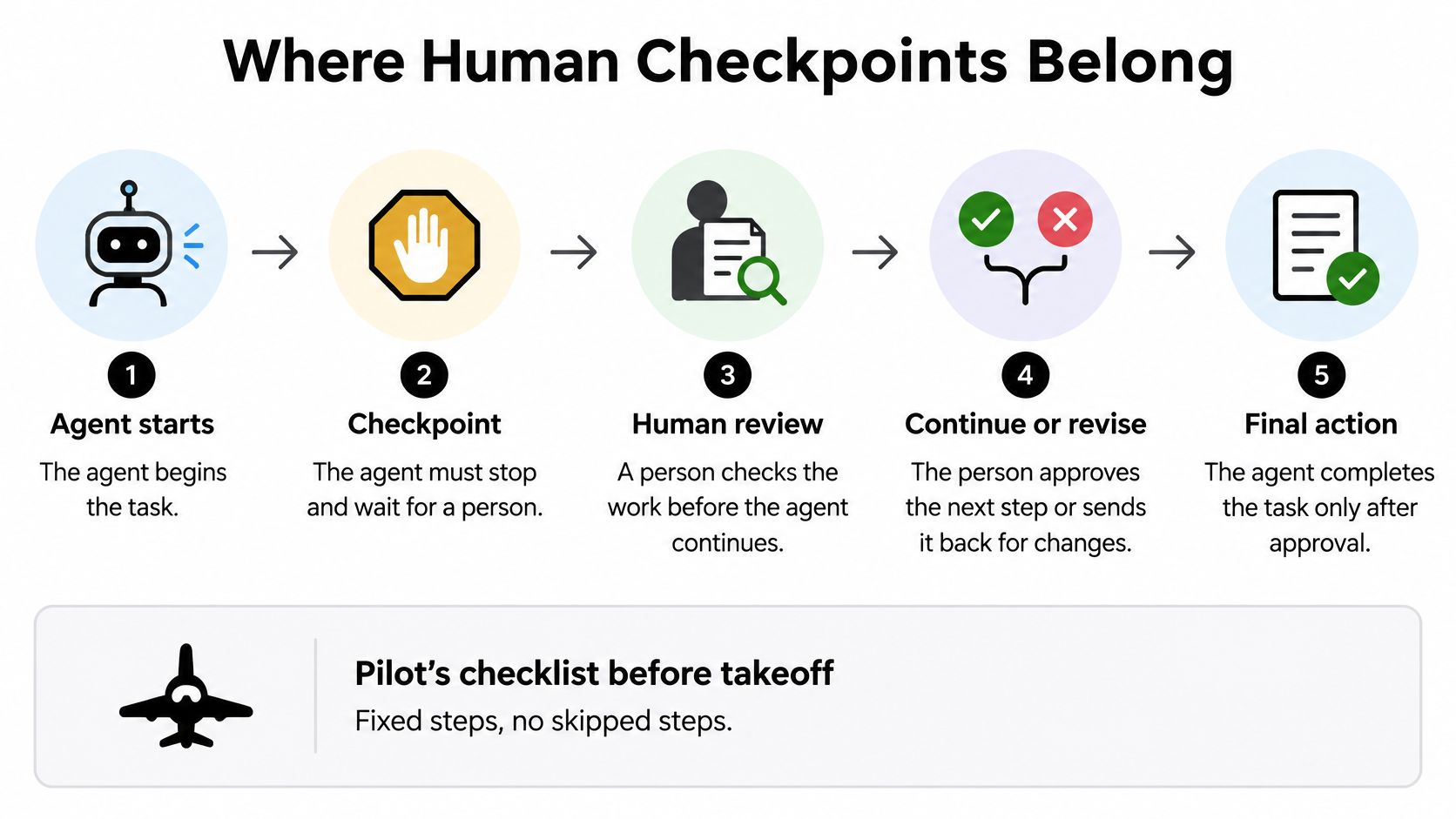
Place gates around consequential decisions
- List possible actions. Include reading files, drafting documents, changing code, merging, deploying, and deleting data. You can't place useful gates around actions you haven't identified.
- Sort actions by practical risk. Reading approved, non-sensitive files or drafting text may be low risk. Branch changes may be medium risk; production deployment and deletion are high risk. Sensitive data can make reading high risk too.
- Gate high-risk actions and stage changes. Require approval before consequential execution and before moving from approved design into coding.
- Assign a reviewer. Give that person the proposed change, relevant evidence, known failures, and the exact next action they're authorizing.
- Provide a stop control. Authorized reviewers need a clear way to interrupt work, not merely leave a comment.
Our draft documents indicate whether an agent is reviewing them. Publish now and Finish review ask for confirmation before stopping that agent review, making the interruption explicit.
Reviewer rule: Approval should identify the artifact and version being accepted, plus the action allowed next.
A checkpoint must be a decision, not a routine click. Use this guide to human-in-the-loop AI agents to shape the handoff, then draw the gates on a simple map of your own process.
Limiting What Each Agent Can Touch
Least privilege means giving an agent only the access its task needs. A review agent can read a design without changing code. A coding agent can write to a feature branch without merging into the main branch.
An operations agent might inspect deployment status but need approval to restart production services. These boundaries should be enforced by credentials and tool controls, not just written in a prompt.
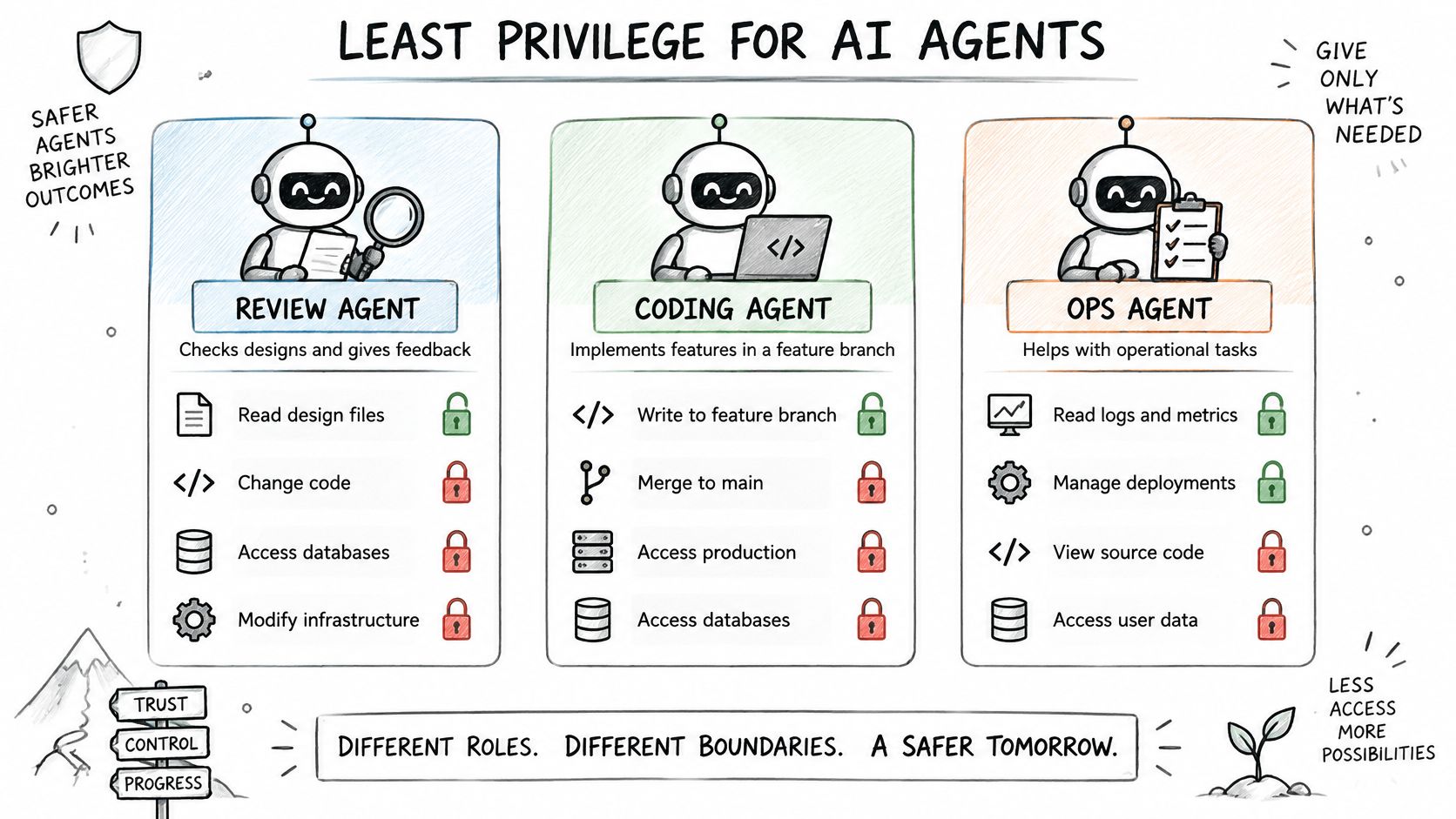
Make permission temporary and revocable
A checkpoint won't protect work that happens outside its boundary. If an agent has unrestricted credentials while preparing a change, it may alter systems before the reviewer gets involved.
- Give each agent an identity. Avoid shared human credentials, so actions remain attributable.
- Write a tool allowlist. Name the permitted tools and operations. Allowing an unrestricted shell can undermine a narrow-looking list.
- Scope each task. Limit access to the required repository, branch, environment, and work item.
- Set an expiry. Use short-lived credentials where possible and revoke access when the task ends.
- Test emergency revocation. Aim to stop access within minutes. Verify that active sessions, queued work, and delegated tools can no longer act.
We recommend a second GitHub account for agents to open pull requests, so you can approve them. Pair that separation with branch protection that prevents the agent account from approving or merging its own work.
Don't assume removing a tool from an interface removes the underlying authority. Test the rejected action directly with the agent's credentials in a safe environment.
This week, write an allowlist for one workflow. Remove every tool or permission that no task needs.
Keeping Records You Can Audit
Say a bug reaches production. You need the approved design, the agent run that wrote the code, its tool calls, the review result, and the person who approved the merge. If a link is missing, the investigation can stall.
Auditability means reconstructing events in order and showing who authorized each transition. The NIST Generative AI Profile identifies auditing, assessment, change management, actor credentials, and data provenance as relevant controls.
Keep a connected evidence trail
Each run's record should include:
- Identity and setup: Agent identity, model version, and prompt or policy version.
- Task context: Work item, approved design, and relevant inputs, with secrets redacted.
- Execution: Tool calls, timestamps, results, and generated outputs.
- Human decisions: Approvals, rejections, reviewer identity, and overrides.
- Outcome: Commit, pull request, deployment state, and any rollback.
Our implementation worker writes notes tagged build-notes. A fix round answers a review finding with evidence under Review answers, which the next agent review checks. Keeping findings and answers with the work item makes the review trail easier to follow.
Store records in an append-only system, where ordinary users can add entries but can't rewrite earlier ones. Hash each entry and protect the hashes separately or chain them together; a hash stored beside an editable record isn't sufficient protection by itself.
A useful record connects a decision to evidence. A long transcript alone doesn't do that.
Use AI agent observability to connect run details with workflow outcomes. As a practical test, choose an event and try tracing it end to end within an hour, then check whether a reviewer could detect a deliberately edited test entry within that same target.
Choosing Models and Tracking Their Results
Choose models by task fit, not reputation alone. Check cost per finished task, where data is stored, the provider's terms, and how easily you can switch later.
Compare authority separately from model capability. A model restricted to reading approved text presents different risks from the same model connected to deployment tools.
ISO/IEC 42001 provides an AI management-system approach covering responsibilities, risk management, lifecycle controls, performance evaluation, and continual improvement. Apply its plan-do-check-act loop: set the target, run the work, inspect results, and adjust controls.
Metrics to track for each agent workflow
Treat these warning signs as suggested operating rules, not industry benchmarks.
| Metric | What it tells you | Warning sign |
|---|---|---|
| Agent success rate | Share of runs finished without help | Falls for two weeks in a row |
| Human intervention rate | How often a person must step in | Rises after a model or prompt change |
| Policy-violation attempts | Actions the agent tried that were blocked | Repeated attempts on the same task |
| Tool-call denials | Tool requests refused by the allowlist | Denials that keep recurring |
| Rollback frequency | How often a change is reverted | Any sustained increase |
| Cost per completed card | Spend for each finished task | Cost rises while success stays flat |
| Fix rounds per card | Review loops before approval | Count climbs above your agreed limit |
| Hours to merge | Time from start to merged change | Long waits after reviews pass |
Review these measures weekly, alongside escaped defects and merge outcomes. Keep definitions stable so a model change doesn't also change how you count success.
If fix rounds rise after switching models, pause the rollout or run a controlled comparison. Give both models similar tasks, the same tool access, and the same review criteria; compare completed work rather than code volume.
Run a one-week test with two models on the same type of task. Write down your acceptance thresholds before starting, including what would trigger rollback, further review, or restricted permissions.
Compliance Dates and Standards to Track
The EU AI Act sorts obligations by risk level, the way building codes demand more of a hospital than a garden shed. What your agent does, and who it affects, determines which rules apply. The law can also reach providers outside Europe that offer AI systems to European users, so your team's location alone does not settle the question.
The European Commission's implementation timeline sets out the phased rollout, from entry into force on 1 August 2024 to 2 August 2026, when most remaining provisions apply. Deadlines for high-risk systems have been revisited in ongoing EU amendments, so confirm the current dates on that same timeline before you plan around them. And don't assume every coding agent counts as high-risk. An assistant that drafts pull requests for human approval sits in a different position than systems making decisions about people.
Key AI governance dates and standards
| Law or standard | What it asks | Key date |
|---|---|---|
| EU AI Act entry into force | Risk-based rules and phased rollout | 1 August 2024 |
| EU AI Act first provisions | Prohibited practices, definitions, and AI-literacy duties | 2 February 2025 |
| EU AI Act general-purpose AI and governance | Rules for general-purpose AI models and oversight bodies | 2 August 2025 |
| EU AI Act most remaining provisions | Transparency and enforcement of applicable rules | 2 August 2026 |
| NIST AI RMF 1.0 | Ongoing governance, mapping, measuring, and managing risk | January 2023 |
| ISO/IEC 42001 | Management system with a plan-do-check-act loop | 2023 |
Management standards and risk frameworks work differently from legislation. They are not automatic legal obligations for every team, but they give you a structure for controls while counsel confirms which legal duties apply. Both standards reward the same habit a working framework builds anyway: written permissions for each agent, and records you can produce when someone asks for proof.
Turn compliance planning into assigned work:
- Identify markets and uses. Document who uses your agents and which decisions or actions they support.
- Map applicable dates to tasks. Separate documentation, technical controls, training, and monitoring.
- Name responsible people. Give each obligation an accountable owner before it applies.
- Prepare evidence. Keep approvals, test results, and activity records accessible for review.
This is planning help, not legal advice. Ask counsel to confirm your product's classification, obligations, and current implementation dates.
Add 2 August 2026 to your plan now as the milestone for most remaining provisions, and verify what your team needs ready by then.
Start With One Workflow
Use a four-week rollout as a practical starting plan, not a promise that every workflow will be ready on that schedule.
A small rollout you can inspect
- Week one: Select a contained workflow and name its owner. Our readiness guide checks project prerequisites, including a connected agent, a ready bridge, and the agent account that pushes code.
- Week two: Map stage transitions, mark high-risk actions, and assign agent identities. Check that reviewers can see exactly what they're approving.
- Week three: Configure the allowlist, task scope, and access expiry. Rehearse emergency revocation until it meets your minutes-level stopping target.
- Week four: Enable run, tool-call, review, and override records. Choose five workflow metrics and hold the first review in a monthly review cycle.
Loupe runs coding agents across design, implementation, and review on a board with human approval checkpoints. In technical design, an agent writes from the approved product, another agent reviews first, and you comment and approve. You retain ownership of documents, versions, comments, suggestions, and decisions.
Use these AI agent examples to select a manageable starting point. Expand to the next workflow only after you can demonstrate that the first workflow's controls work.
Loupe offers a board-based workflow for coding agents with defined stages, review trails, and human decision points. Visit Loupe to explore how you can organize agent work around clear approvals and accountable delivery.