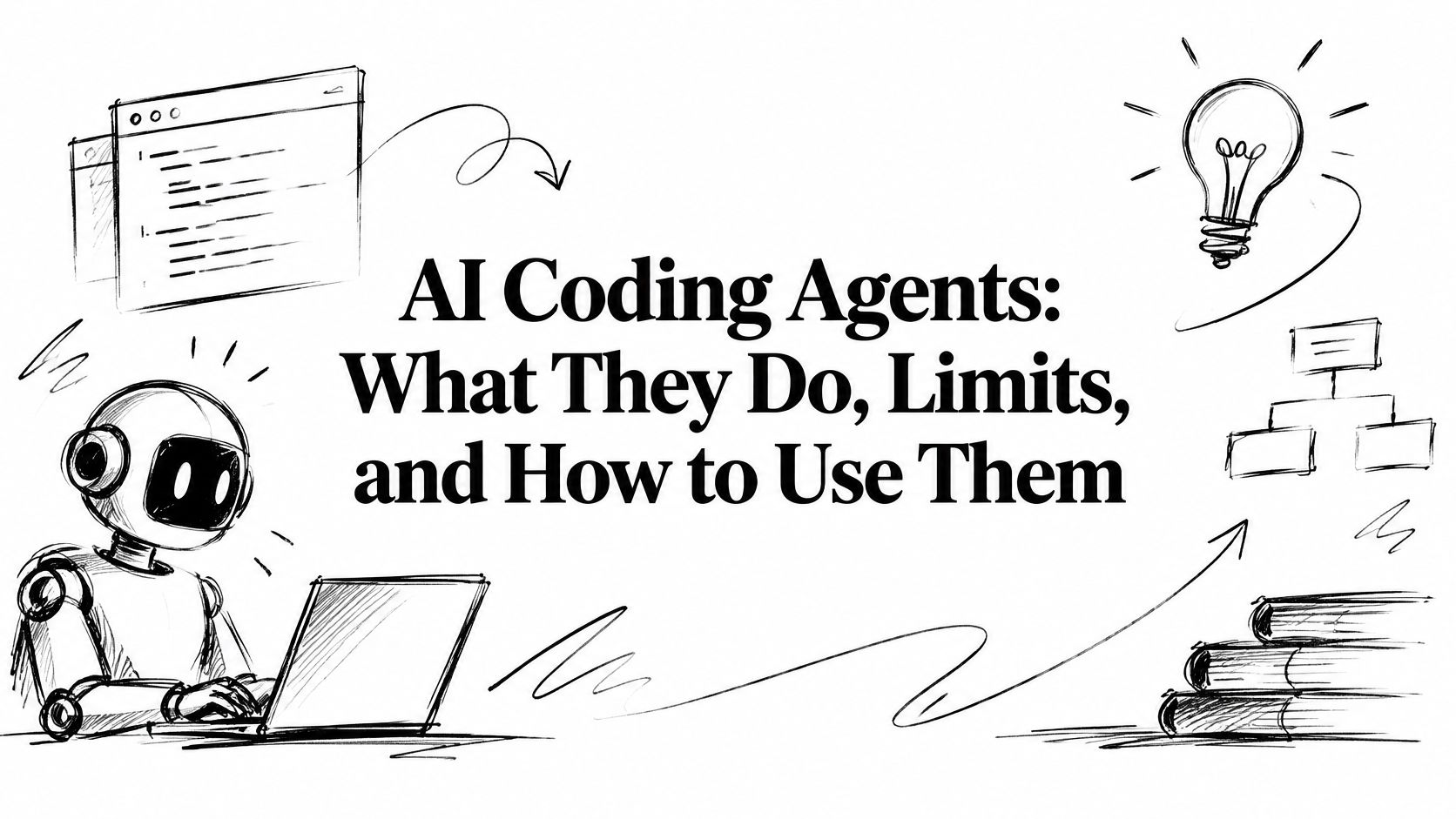
AI Coding Agents: What They Do, Limits, and How to Use Them
AI coding agents can plan, edit, test, and open pull requests. See what they do well, where they fail, and how to add them to your workflow.
In this article
- AI Coding Agents in 2026
- From Autocomplete to Agent
- The agent loop
- What autonomy changes
- What AI Coding Agents Can Do Today
- Read benchmarks as task calibration
- Where AI Coding Agents Fall Short
- Correct code can implement the wrong requirement
- Functional correctness isn't security
- Fast completion can hide poor acceptance
- Real-World Examples of AI Coding Agents at Work
- A startup routes ready bugs
- A platform team approves designs before code
- A vague refactor creates avoidable work
- How to Measure Whether AI Coding Agents Pay Off
- Count accepted work and verification effort
- Use the measures to assign autonomy
- How to Integrate AI Coding Agents and Roll Them Out
- Establish operating boundaries
- Run a contained pilot
AI coding agents are AI systems that take a whole development task, plan it, edit code across files, run tests, and iterate with limited supervision, unlike autocomplete, which only predicts the next lines.
The important question isn't how quickly they write code. It's how much work your team must do before that code deserves to ship.
AI Coding Agents in 2026
Only 36% of developers who had used agents believed they improved code quality, according to Stack Overflow's 2025 Developer Survey, which collected responses from 31,877 developers. In that survey, 14.1% used agents at work daily, about 31% used them at some frequency, 17.4% planned to adopt them, and 13.8% used AI only in copilot or autocomplete mode.
Those are different ways of working. A developer accepting a suggested function still directs each step. A developer assigning a ticket to an agent delegates some decisions about what to read, change, and test.
Say your application exports customer records, but empty exports crash. With autocomplete, you find the failing function and write the fix with suggestions. With an agent, you provide the reproduction steps and expected behavior, then let it investigate and prepare a patch.
The useful unit of progress is an accepted change, not generated code.
That difference changes the manager's job. You need a clear task, an environment where the agent can work safely, and someone responsible for deciding whether the result meets the requirement.
A practical starting agreement is:
- The agent owns execution. It investigates, proposes changes, and reports validation results.
- The team owns intent. People decide expected behavior, acceptable risk, and architectural boundaries.
- A reviewer owns acceptance. Passing tests is evidence, not permission to merge.
AI coding agents are useful for some development work, but adoption remains uneven. Understanding their capabilities and limits matters; designing the handoffs matters more. Treat workflow design as the main investment, rather than expecting a model switch to fix unclear requirements or weak review.
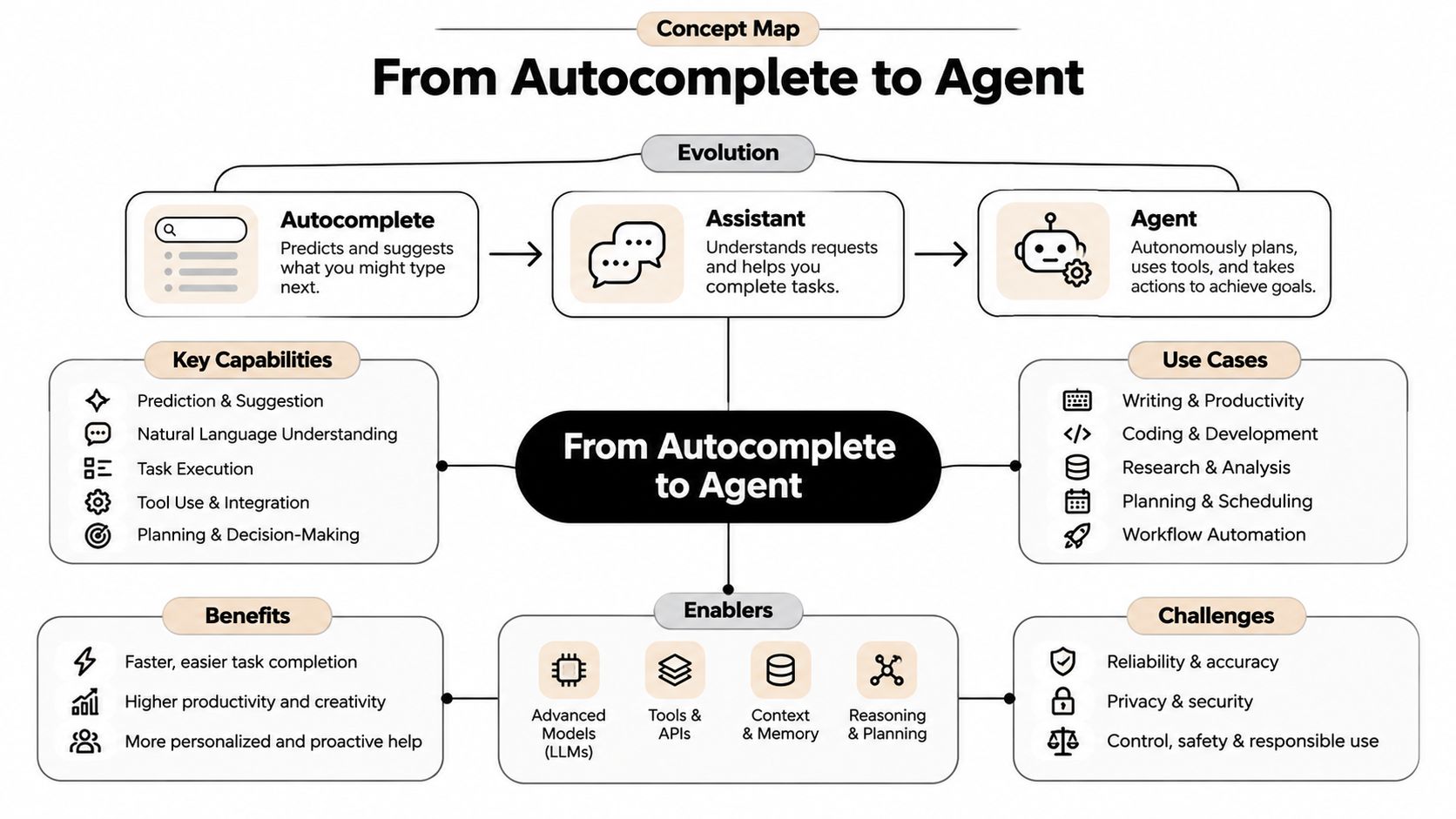
From Autocomplete to Agent
Autocomplete is like a fast typist beside you. It suggests what comes next, while you decide where to go.
An agent is closer to a junior engineer handed a ticket. That analogy describes delegation, not judgment or accountability: an agent can work independently, but it still needs a useful specification and careful review.
The agent loop
An agent's working loop usually follows this sequence:
- Read the task. Inspect the issue, repository instructions, and relevant code.
- Plan the steps. Identify likely changes, dependencies, and validation commands.
- Edit the repository. Update implementation, tests, and supporting files.
- Run validation. Execute the build, linters, and relevant tests.
- Interpret feedback. Repair failures or report a blocker that needs a human decision.
The important addition is tool access. A language model can suggest a shell command; an agent system can execute that command, inspect the output, and choose another action.
That doesn't mean every agent can perform every step. Its actual scope comes from the tools, credentials, network access, and workflow rules you give it.
AI autocomplete versus AI coding agents
| Aspect | AI autocomplete | AI coding agent |
|---|---|---|
| Scope of work | Suggests the next lines in the file you are editing | Takes a whole task from ticket to pull request |
| Planning | None, predicts one completion at a time | Breaks the task into steps and adjusts the plan when tests fail |
| Files touched | Usually one file at a time | Many files across the repository |
| Tests | You notice and fix failures yourself | Runs the test suite, reads failures and iterates |
| Your role | Write and review every line | Set the task, approve the plan, review the result at checkpoints |
| Typical failure | A suggestion you simply reject | A complete change that is confidently wrong |
What autonomy changes
For the export bug, an agent might trace the request handler, update the serializer, add a regression test, and open a pull request. You no longer need to direct every edit.
But you must check whether an empty export should return a blank file, headers only, or a validation message. A technically clean patch can implement the wrong answer.
An agent doesn't just write code. It decides what to do next, which is why workflow design matters more than model choice.
Agents convert some writing time into review time. Whether that trade is worthwhile depends on how easily your team can verify the result.
What AI Coding Agents Can Do Today
Start with tasks whose success you can describe and check. A reproducible bug gives an agent a stronger target than a request to improve the application.
Use the table as a task-selection guide. The pattern is checkpoint-based autonomy: give the agent a bounded objective, let it run tools between checkpoints, and inspect the spec, tests, and pull request before anything merges.
What AI Coding Agents Handle Well, Task by Task
| Task | What the agent handles | How well it works today | Keep a human for |
|---|---|---|---|
| Bug fixes from an issue | Reproduces the bug, locates the code, proposes a patch, runs tests | Useful on reproducible defects; issue benchmarks still leave many tasks unresolved | Ambiguous or flaky reproductions |
| Writing and repairing tests | Generates unit tests, fixes broken assertions, raises coverage | Strong fit when expected behavior is defined outside the patch | Deciding what is worth testing |
| Small feature implementation | Edits several files, follows a design note, opens a pull request | Good fit with a clear spec and existing code patterns | Interface and UX trade-offs |
| Refactoring | Renames, extracts and migrates code while keeping tests green | Good fit when existing tests protect behavior | Architectural direction |
| First-pass code review | Checks a diff against the design and flags gaps | Works as a filter before human review | Security calls and final approval |
| Docs and migrations | Drafts READMEs, changelogs, codemods and upgrade scripts | Good fit for routine, established patterns | Public-facing wording and migration safety |
Test writing deserves special care. An agent can produce a passing assertion that merely repeats its own mistaken implementation. Ask it to derive expected behavior from the requirement, and preserve independently written regression tests.
Migration scripts need a similar boundary. Generating a script is separate from approving it to modify production data. Inspect rollback behavior, run it against representative fixtures, and require explicit approval before real data changes.
Read benchmarks as task calibration
SWE-bench shifted evaluation from isolated snippets toward real repository issues: inspect existing code, make changes, and pass project tests. The SWE-bench live-evaluation paper reports a 43.20% resolved rate in its evaluation.
Task selection changes the picture sharply. The SWE-Bench Pro analysis reports approximately 23% for leading systems on SWE-Bench Pro versus more than 70% on Verified.
Treat these as ceilings for the tested configurations and selected tasks, use them to calibrate difficulty, and keep product requirements as a separate check. For local evaluation, give competing agents the same starting commit, task description, tools, and acceptance checks. Keep evaluation tests and target patches out of reach. Then ask whether a human would accept the change, beyond whether the agent declared completion.
Where AI Coding Agents Fall Short
A patch can compile and still solve the wrong problem. Semantic errors, where the code does something coherent yet different from what was asked, are a common failure mode, and they slip through the checks teams rely on most: syntax, types, and tests the agent wrote for itself. Constrain meaning before implementation rather than depending on compiler feedback alone.
Correct code can implement the wrong requirement
Suppose a ticket asks the agent to prevent duplicate payments. It might deduplicate requests by customer identifier, accidentally blocking legitimate repeat purchases.
The syntax could be valid. The tests it writes could pass. The requirement is still wrong.
Three controls expose this kind of mistake:
- State invariants. Explain what must remain true, such as allowing distinct purchases from the same customer.
- Approve consequential decisions. Require a human decision on payment semantics, authorization, and data ownership.
- Review against the specification. Ask a separate reviewer to identify requirements the patch hasn't satisfied.
That review works best as a checkpoint before code is written, when correcting intent costs a comment instead of a refactor.
Functional correctness isn't security
A technology analysis of the agentic software development lifecycle cites findings that 61% of AI-generated code was functionally correct but only 10.5% was secure, 49% of agent-recommended dependencies contained known vulnerabilities, and critical vulnerabilities increased 37.6% after five agent iterations without embedded security checks.
Your repository's risk rate will differ. What transfers is the separation: a patch can pass every functional check and still open an authorization hole, so functionality and security need separate acceptance checks.
Run dependency scanning and static security analysis alongside tests. Inspect authorization paths, secret handling, input validation, and new network calls. Don't let an agent add a dependency because its proposed API looks convenient.
Practical rule: A green test suite proves only what those tests checked.
Fast completion can hide poor acceptance
A study of autonomous coding-agent pull requests found that some agents completed half their pull requests within 13 minutes, yet agent-authored pull requests were accepted less often than human-authored ones; Codex pull requests were reviewed and merged faster than human-authored changes.
Treat completion time as a cost signal. A fast patch still has to earn its merge, so review the places speed tends to hide problems: unexplained scope changes, weakened assertions, disabled checks, and claims unsupported by command output.
Measure acceptance rather than velocity. Track merge acceptance rate, fix rounds per change, and cost per merged pull request for each task type you delegate. An agent that succeeds on a bounded issue may struggle when success requires product judgment across services, so let those numbers, rather than a leaderboard, decide where you widen autonomy.
Every agent change is a draft that must earn its merge.
All three failure modes share a shape: the agent produces something plausible, and the gap only shows when someone checks the work against intent. Loupe builds that check into the workflow. It connects a coding agent on your machine to a review system where agents send plans and you review them in the browser, and a second agent reviews each design and each pull request against the approved design, sending weak work back for fixes before you see it. Loupe runs no AI models itself: you bring Claude Code or Codex on your own subscription or API key, with your agents, your machine and your rules.
Real-World Examples of AI Coding Agents at Work
These are hypothetical workflows, not customer case studies. They show how teams can structure delegation without inventing performance results.
A startup routes ready bugs
Say a small startup adds an agent-ready label to bug reports with reproduction steps, the affected area, and acceptance criteria. An agent picks up a labelled ticket, reproduces the failure, and drafts a patch with a regression test.
Continuous integration and a security scan run before a human reviews the change. If the reproduction is ambiguous, the agent returns a question instead of guessing.
The team measures backlog age and accepted fixes for this task category. It should expand the workflow only if those measures improve without adding review burden or escaped defects.
The lesson is straightforward: ticket readiness is part of implementation quality. A vague report shouldn't become eligible merely because an agent is available.
A platform team approves designs before code
A platform team wants a new account-management screen. An agent drafts a product document and clickable prototype, a separate agent reviews them, and a product owner approves the intended behavior.
Next, an agent prepares the technical design, including permissions, API changes, and data flow. Agent review and human approval happen before implementation starts.
The implementation agent then opens a pull request, and a reviewer agent checks it against the approved design. A human inspects the preview and annotates UI problems, with those notes attached to the work item.
The team measures design deviations discovered during review and the fix rounds needed before acceptance. The benefit to test is whether early decisions reduce late rework, not whether the prototype appears quickly.
For more workflow patterns, explore these AI agent examples.
A vague refactor creates avoidable work
Consider a team that hands an agent a ticket saying only to clean up account handling. The agent merges similar-looking paths that enforce different access rules.
Reviewers must reconstruct the original intent, separate the behaviors, and repair the change. A plausible implementation has created work rather than removed it.
The corrective action isn't automatically a stronger model. Add a readiness checklist requiring expected behavior, protected interfaces, explicit exclusions, and a named decision-maker.
Delegate a bounded outcome, not an invitation to reinterpret the system.
How to Measure Whether AI Coding Agents Pay Off
Agent speed is visible. Review effort is easier to miss, especially when developers interrupt other work to understand a large generated diff.
In Stack Overflow's survey of AI use, 52% of developers believed AI tools or agents improved productivity, while 46% distrusted AI accuracy versus 33% who trusted it. That gap is a reason to measure the complete delivery process.
Count accepted work and verification effort
Verification Economics for AI Coding Agents
| Metric | What it tells you | How to calculate | Target or warning sign |
|---|---|---|---|
| Cost per merged pull request | Full cost of agent work that actually ships | Add runtime, review, rework and CI cost; divide by merged agent PRs | Falling without more escaped defects |
| Fix rounds | How much iteration the spec and tests forced | Count agent test-fix cycles from first patch to accepted merge | Rising rounds suggest weak specs or task mismatch |
| Review duration | Human time the agent adds or saves | Track active human review minutes between PR opening and approval | Long reviews can erase implementation savings |
| Escaped defects | Quality failures found after merge | Divide post-merge bugs or incidents by agent merges; normalize to a consistent reporting unit | Any security escape is a stop signal |
| Merge acceptance rate | Whether agent output survives review | Merged agent PRs divided by agent PRs opened | Below the comparable human baseline needs investigation |
| Time to merge | Delivery speed, read with quality | Median hours from PR opening to merge | Useful only beside acceptance and escaped defects |
Separate active review time from elapsed waiting time. Otherwise, a pull request sitting overnight looks like expensive human verification.
Include failed and abandoned runs in cost totals. Excluding them makes an unreliable agent look artificially cheap.
Use the measures to assign autonomy
Compare similar tasks under the same acceptance rules. Don't compare agent-written documentation with human-written authorization changes.
A model cost comparison can help frame runtime spending, but token prices aren't the complete business case. A cheaper run that requires extensive repair may cost more per accepted change.
Give more independence to task categories that sustain acceptance and quality. Pause expansion when security defects escape, acceptance falls, or reviewers spend more effort checking changes than they save implementing them.
How to Integrate AI Coding Agents and Roll Them Out
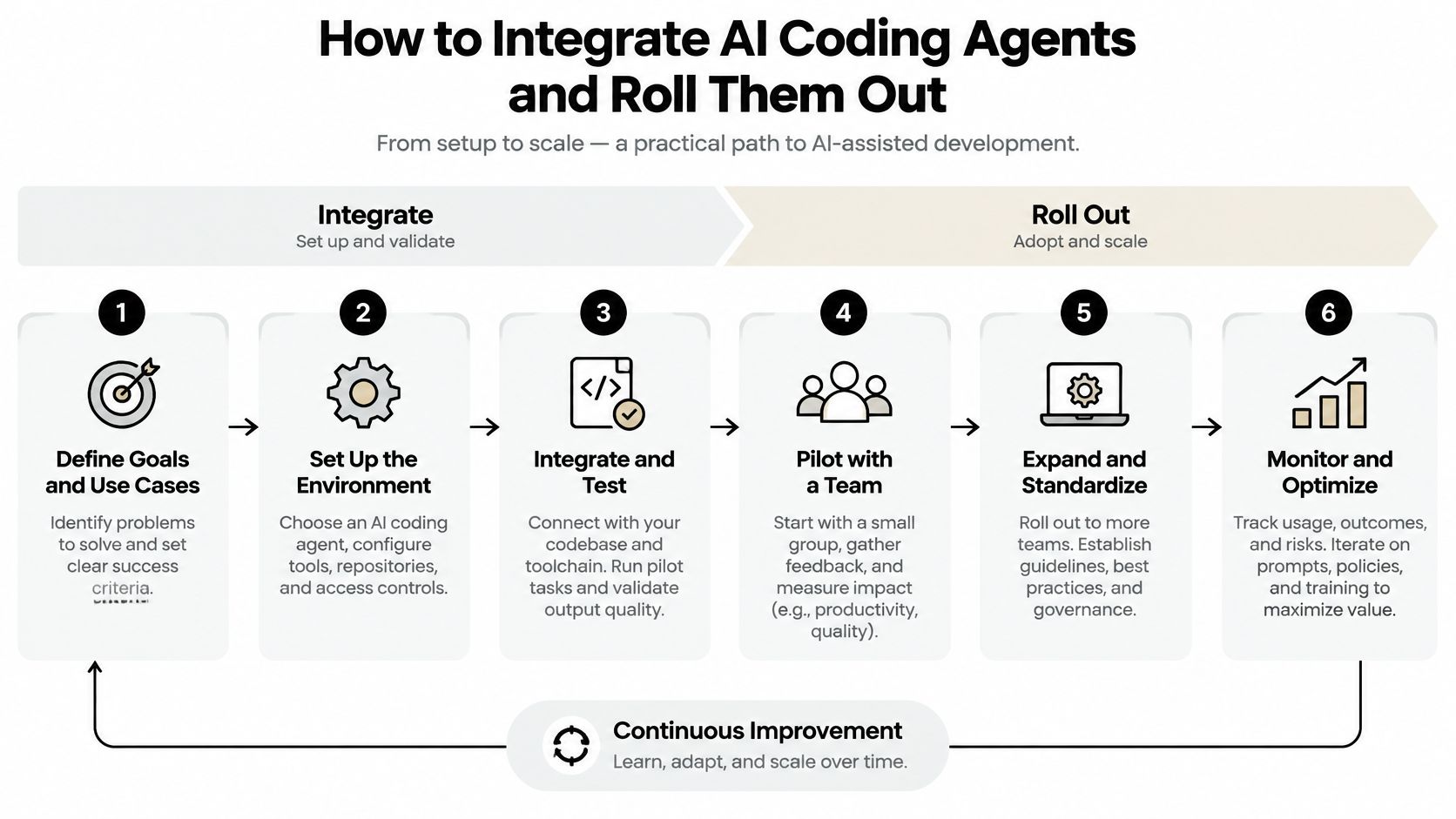
Use checkpoint-based autonomy: let the agent execute within a defined boundary, then stop where a person must decide. Approval should authorize a specific next action, not grant unrestricted trust.
Stack Overflow's developer survey announcement reports that approximately 70% of workplace agent users said agents reduced time on development tasks. Your rollout should test whether that benefit survives your team's acceptance process.
Establish operating boundaries
Choose bounded work. Start with reproducible bugs, tests for documented behavior, and small features using existing patterns. Keep broad architecture changes and production data operations out of the initial queue.
Require an executable specification. Include acceptance criteria, relevant files or services, validation commands, and exclusions. Write what the agent should do when requirements conflict: pause and ask, rather than choose on its own.
Keep approval authority explicit. Assign owners for plan approval, pull-request review, and merge. A study of 29,585 pull-request lifecycles across five coding-agent tools found collaborator-style tools were at least 96% agent-initiated, while final merge authority remained almost exclusively human.
Layer independent checks. Run tests, dependency scans, and security checks. Add a separate agent review against the approved design, but don't treat agreement between agents as proof of correctness.
Instrument the work item. Record runtime spending, human review effort, fix rounds, acceptance, and post-merge defects. Require evidence such as command results and explanations of unresolved failures.
Restrict permissions. Use least-privilege credentials, a separate agent Git identity, isolated workspaces, and command restrictions. Keep production secrets unavailable and require approval for destructive actions.
Expand by task category. Broaden the agent's scope only when comparable accepted changes justify it. Preserve a clear way to stop execution, revoke credentials, and hand the task to a developer.
The permission boundary deserves operational ownership. In a survey of more than 100 security leaders and architects, 69% of organizations had moved beyond experimentation into real-world agent deployments, but only 21% maintained a complete, current inventory of agents and MCP connections, and 79% lacked governance policies covering permissions and monitoring.
Maintain an inventory listing each agent identity, repository access, connected tools, credential owner, and revocation procedure. Treat issue text, repository files, and external pages as untrusted inputs, not authority to change permissions.
Run a contained pilot
Use a month-long pilot as an operating plan, not a promise of results:
- Opening week: Select a narrow set of task categories, write readiness criteria, and establish a comparable human baseline.
- Contained execution: Run eligible work in isolated environments with tests, scans, and a separate Git identity.
- Review and measurement: Add design-conformance review and inspect cost per merged pull request, fix rounds, and acceptance.
- Policy decision: Decide which categories deserve more autonomy and write a concise policy covering approvals, permissions, escalation, and incident response.
For approval design, use these human-in-the-loop agent workflow patterns. Make pending questions visible to a named owner so blocked agents don't keep guessing.
Loupe is a software factory for coding agents that runs with your agents, your machine, and your rules, orchestrating work on one board with human checkpoints; it's self-hostable with Docker under AGPL. Our readiness guide checks the connected agent, ready bridge, and agent account that pushes code, and you bring Claude Code or Codex through your own subscription or API key.
Start narrow, measure, and expand on evidence. Well-specified work with layered review is a better starting point than full autonomy.
Bring a bounded development task to Loupe and organize it from approved design through implementation and review. Use its human checkpoints and workflow metrics to test whether agent execution reduces total delivery effort, not just coding time.