Technical Design Review Checklist: 8 Items for 2026
Use this technical design review checklist with 8 prioritized items, acceptance criteria, common pitfalls, and reviewer roles for agent-driven teams.
In this article
- 1. Problem Statement and Goals
- Check that the target is understood
- 2. Scope and Non-Goals
- Keep review units coherent
- 3. Architecture and Component Overview
- Review boundaries, not just boxes
- 4. Data Model and Storage
- Make the transition reviewable
- 5. APIs and Interfaces
- Check future change cost
- 6. Security and Privacy Review
- Define agent authority
- 7. Scalability, Performance, and Reliability
- Require recovery evidence
- 8. Testing, Observability, and Rollout Plan
- Make rollback executable
- How the 8 checklist items compare at a glance
- Make the Checklist Part of Every Design Cycle
- Record findings that someone can close
- Verify the answer, not just the edit
Your design passed review. The build shipped. Six weeks later, a failed migration exposes a missing rollback plan, and nobody can agree who owns the affected customer data. The diagrams looked clear. The approval was real. The operational decisions were never made.
A technical design review checklist helps catch those gaps before an agent starts building. But a checked box isn't enough. Reviewers need an owner, evidence, and a clear rule for closing each finding. Otherwise, the team just moves uncertainty from a document into production.
In Loupe, work moves from tech design to implementation, agent review, and live review, with configurable human checkpoints along the way. A second agent reviews the draft design before owner review, then reviews the implementation against the approved design. Fix rounds answer the findings instead of leaving them buried in a conversation.
Practical rule: Approve evidence and decisions, not just a document that looks finished.
Use the following checks in order. Give agents the repeatable work, such as comparing contracts and checking coverage. Keep humans responsible for product intent, accepted risk, data ownership, and release authority. Those responsibilities shouldn't disappear because an automated reviewer returned a clean result.
1. Problem Statement and Goals
Start with the user's problem, not the proposed service. A reviewer should understand who needs the change, what's broken today, and what a successful result would look like before reading any architecture.

For example, a report-export design might solve a specific problem: customers can't finish large exports without keeping their browser open. The goal is reliable background delivery, not only adding a queue. Write measurable targets where possible, such as page loads under 2 seconds, clearly labeled as proposed acceptance criteria rather than proven performance.
Keep the problem to one or two paragraphs. Kubernetes Enhancement Proposals offer a useful pattern: motivation and goals come before design details. Your technical design document should make the same distinction.
Check that the target is understood
Ask the reviewer to restate the problem without copying the opening paragraph. If they describe a different user or outcome, resolve that mismatch before implementation planning.
- Human owner: The product owner confirms the user need and accepts the success criteria.
- Agent check: The drafting agent maps each proposed component to a goal. The second agent flags unsupported work and vague acceptance criteria.
- Fix-round evidence: The author rewrites unclear goals and links each one to a testable outcome.
The checklist should reflect the project, not a universal approval form. The Microsoft Research study of code-review practices specifically recommends project-contextual checklists.
Close this gap when the problem, beneficiary, and acceptance criteria agree. Don't approve a solution while reviewers still disagree about why it exists.
2. Scope and Non-Goals
A background export doesn't automatically need scheduled reports, a new dashboard, or a general-purpose job platform. Those might be useful later. They're still separate decisions.
Write both in scope and out of scope before the worker receives the design. Python Enhancement Proposals provide a useful model through sections for rejected ideas or work outside the proposal. Record the reason for exclusion, not just the feature name.
For the export example, list at least three non-goals:
- No scheduling: Users request exports manually. Recurring delivery belongs on a separate card.
- No dashboard redesign: The change adds export status without changing unrelated navigation.
- No platform rewrite: The worker uses the existing job infrastructure unless a documented constraint blocks it.
Link deferred work to new board cards. That gives useful ideas a home without expanding the approved change.
Keep review units coherent
A smaller review package is easier to explain, but splitting work arbitrarily can hide dependencies. Separate unrelated changes while keeping tightly coupled decisions together. A schema change and the compatibility code it requires may need the same review context.
In a controlled study, reviewers assigned decomposed changes addressed the first issue about 14% faster than the control group, according to the change-decomposition study. That doesn't mean smaller packages automatically produce better decisions.
The human technical lead owns scope changes. The second agent compares the proposed implementation plan with the approved boundaries, and the worker answers each mismatch during a fix round.
Recheck scope at every checkpoint marked You. Close findings by removing extra work or explicitly approving a revised design, never by broadening the original promise.
3. Architecture and Component Overview
Show the path a request takes through the system. A diagram full of service names isn't useful unless reviewers can follow calls, data movement, and failure boundaries.
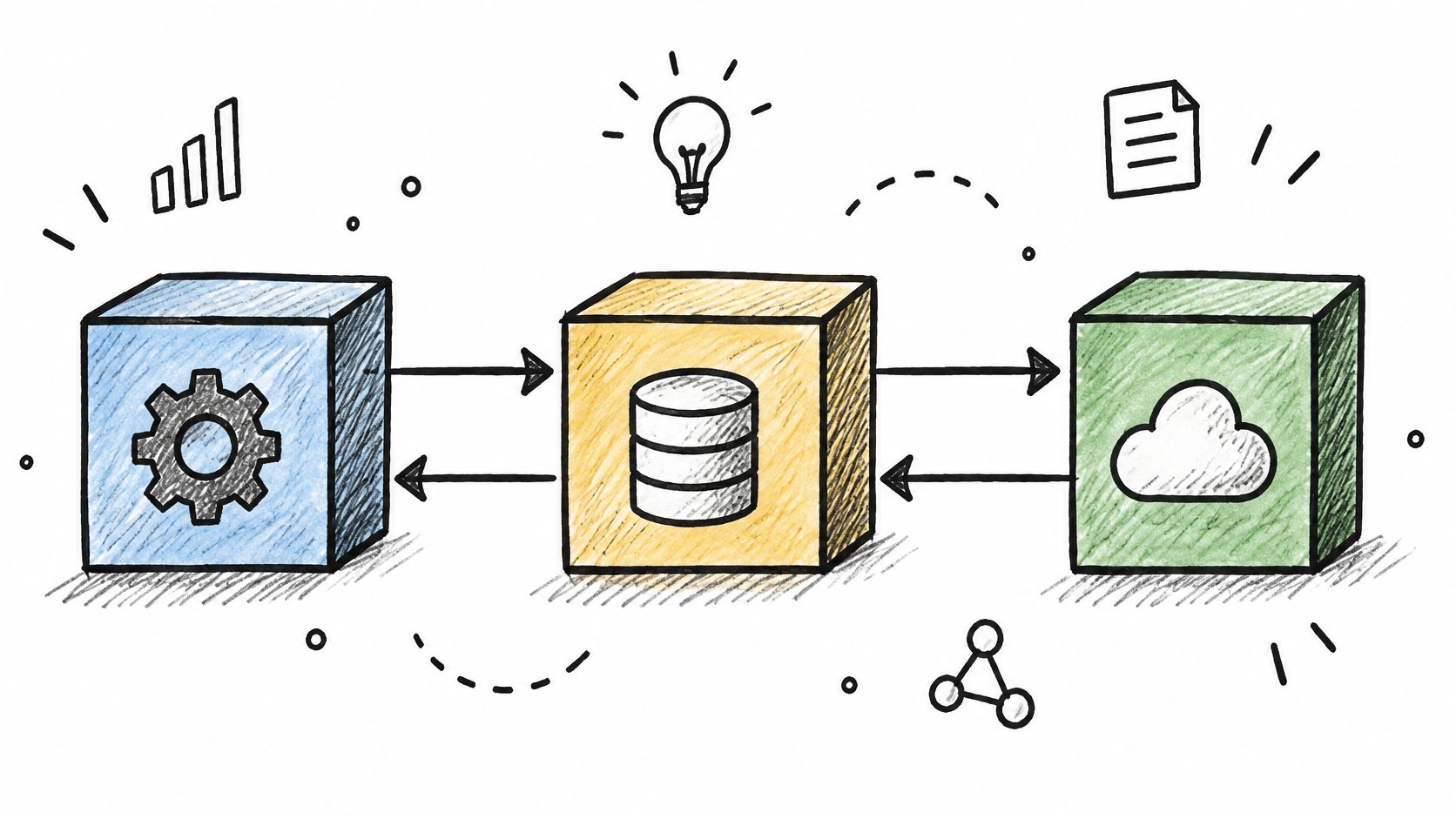
Use the C4 model to keep each view focused. A context diagram shows users and external systems. Container and component views explain the internal structure at closer levels. Don't force every concern onto the same canvas.
For a background export, show the browser, API, queue, worker, object storage, and notification service. Add a short explanation of who creates the job, who updates its status, and what happens when delivery fails.
Review boundaries, not just boxes
Store diagrams as text, such as Mermaid, so authors can revise them alongside the design. Use in-place document comments to attach questions to the relevant component or explanation.
- Dependencies: Name external services and explain what happens when they're unavailable.
- Alternatives: Compare the chosen structure with a simpler option, including the operational cost of each.
- Ownership: Assign a team or role to every component and shared boundary.
NASA's technical review success criteria require evidence that designs meet requirements with acceptable risk and that interfaces and verification plans are sufficiently mature. Apply that principle without copying a heavyweight process into a small web project.
The human architect owns the trade-off. The second agent checks that the diagram and written flow agree. A fix round closes the gap only when the author updates both and explains any changed dependencies.
A visually tidy diagram doesn't compensate for an unnamed owner or an unexplained failure path.
4. Data Model and Storage
Write the migration plan before you consider the schema final. A clean target schema can still require an unsafe transition from today's database.
For the export service, define the job record, tenant identifier, status, storage reference, and deletion state. Name the person or team responsible for that data. Separate business ownership from the service account that can write it.
Postgres, Flyway, and Alembic are practical tools for expressing database changes. The design should explain how the application behaves while old and new code versions coexist, not merely name the migration tool.
Make the transition reviewable
Ask the drafting agent to produce a migration sequence and sample queries. Include the query that lists recent jobs for a tenant, then inspect whether the proposed indexes support its filters and ordering.
- Schema and constraints: Define required fields, uniqueness rules, relationships, and valid state transitions.
- Migration safety: Explain backfills, locking concerns, deployment order, and compatibility with the previous application version.
- Retention and deletion: State how long records and exported files remain, who sets that policy, and how deletion reaches copies and derived data.
A database rollback isn't the same thing as an application rollback. Restoring old code won't recreate deleted data.
The human data owner approves retention and destructive changes. The second agent checks the schema against access rules, queries, and migration steps. It should flag a missing owner as a decision gap, not invent one.
During the fix round, attach the revised migration, query-plan output where relevant, and evidence from a representative test environment. Close the finding when the transition is understood, including what cannot be reversed.
5. APIs and Interfaces
Start with the caller's experience. Can a client submit work safely, understand the response, and recover when the network drops?
For a background export API, define job creation, status lookup, and download access. Include request fields, response shapes, authentication, authorization, errors, and compatibility rules. An OpenAPI specification belongs in the design, before implementation begins.
Don't leave retries implicit. If a client repeats a creation request after a timeout, say whether it gets the existing job or creates another export.
- Inputs and outputs: Specify validation, optional fields, pagination, and identifiers.
- Failure responses: Add at least one example error response for each endpoint, including the client's next action.
- Compatibility: Decide how fields and behavior can change, and plan versioning before the first public release.
Check future change cost
A contract can work today and still be difficult to maintain. An empirical study of industrial and student code reviews found that 75% of the defects discovered during review didn't affect visible functionality, instead improving evolvability. Keep maintainability findings separate from behavior bugs.
For example, a loosely typed status field may pass the happy-path test while leaving every client to guess which values exist. Define the states and transitions explicitly.
The human interface owner approves compatibility commitments. The second agent compares the specification with caller examples and the implementation plan. Later, implementation review checks the code against that approved contract.
A fix round should update the specification, examples, and contract tests together. Don't close an interface finding with a code patch that leaves the design wrong.
6. Security and Privacy Review
Treat every new data flow as a security decision. This matters especially when an agent can send source code, logs, prompts, or customer information to an external service.

Use Microsoft's STRIDE categories to examine each component: spoofing, tampering, repudiation, information disclosure, denial of service, and privilege escalation. Turn each relevant threat into a concrete control and a verification task.
For the export service, test whether a user can request another tenant's job, guess a download reference, or retrieve a file after access expires. Keep secrets in a vault or protected environment settings, never in design documents or committed code.
Define agent authority
Your AI agent governance framework should identify allowed tools, permitted data, and actions that require human approval. Record which external model providers receive data and why.
- Provenance: Record the tool or model used and which artifacts it generated.
- Access boundaries: Limit agent credentials to the task and keep production permissions separate.
- Human escalation: Require security-owner review for sensitive data exposure, permission changes, and high-impact actions.
Research on AI-assisted software engineering discusses provenance, gated reviews, private deployments, and human accountability. A second agent can challenge a threat model, but it isn't an independent security authority merely because it didn't write the design.
The human security owner accepts residual risk. Fix rounds must answer each finding with a changed control, a test result, or an explicit risk decision. Agreement between agents isn't enough to close a security gap.
7. Scalability, Performance, and Reliability
A queue doesn't make a design scalable by itself. Reviewers need to know how quickly work arrives, how much work a job requires, and what happens when processing falls behind.
Write load estimates as formulas. For exports, estimate active customers × export frequency × records per export. State assumptions beside the calculation so the second agent and human reviewer can challenge them.
Define capacity, latency, and uptime targets as proposed requirements. Separate measured results from forecasts, and link benchmark artifacts when they're available.
Require recovery evidence
Netflix's chaos engineering practice is a useful example of testing failure behavior deliberately. For a smaller application, start by exercising the top three failure modes:
- Worker interruption: Explain retries, duplicate prevention, and how abandoned jobs resume.
- Storage outage: Define bounded retries, user-visible status, and a safe fallback.
- Database failure: Describe degraded behavior, recovery ownership, and the conditions for resuming writes.
The USENIX SRE checklist treats data recovery, operator control, manual recovery, and restart-from-scratch procedures as distinct design questions. Set recovery-time and recovery-point objectives, then require restore or recovery evidence.
Approval boundary: The human incident owner decides which recovery actions are safe and who may authorize irreversible steps.
The second agent checks that every failure mode has a response and supporting artifact. A fix round closes the finding with a rehearsal result, revised runbook, or accepted limitation.
Use our cost per finished card and hours-to-merge metrics to compare the engineering effort behind design options. Those metrics help assess delivery trade-offs. They don't replace runtime benchmarks or reliability tests.
8. Testing, Observability, and Rollout Plan
A design isn't ready until reviewers know how the team will prove it works and detect when it doesn't. Tie tests to acceptance criteria, failure modes, security controls, and interface contracts.
For the export service, include unit tests for state transitions, integration tests for storage and queues, and end-to-end tests for delivery. Add failure tests for retries, expired access, and interrupted processing.
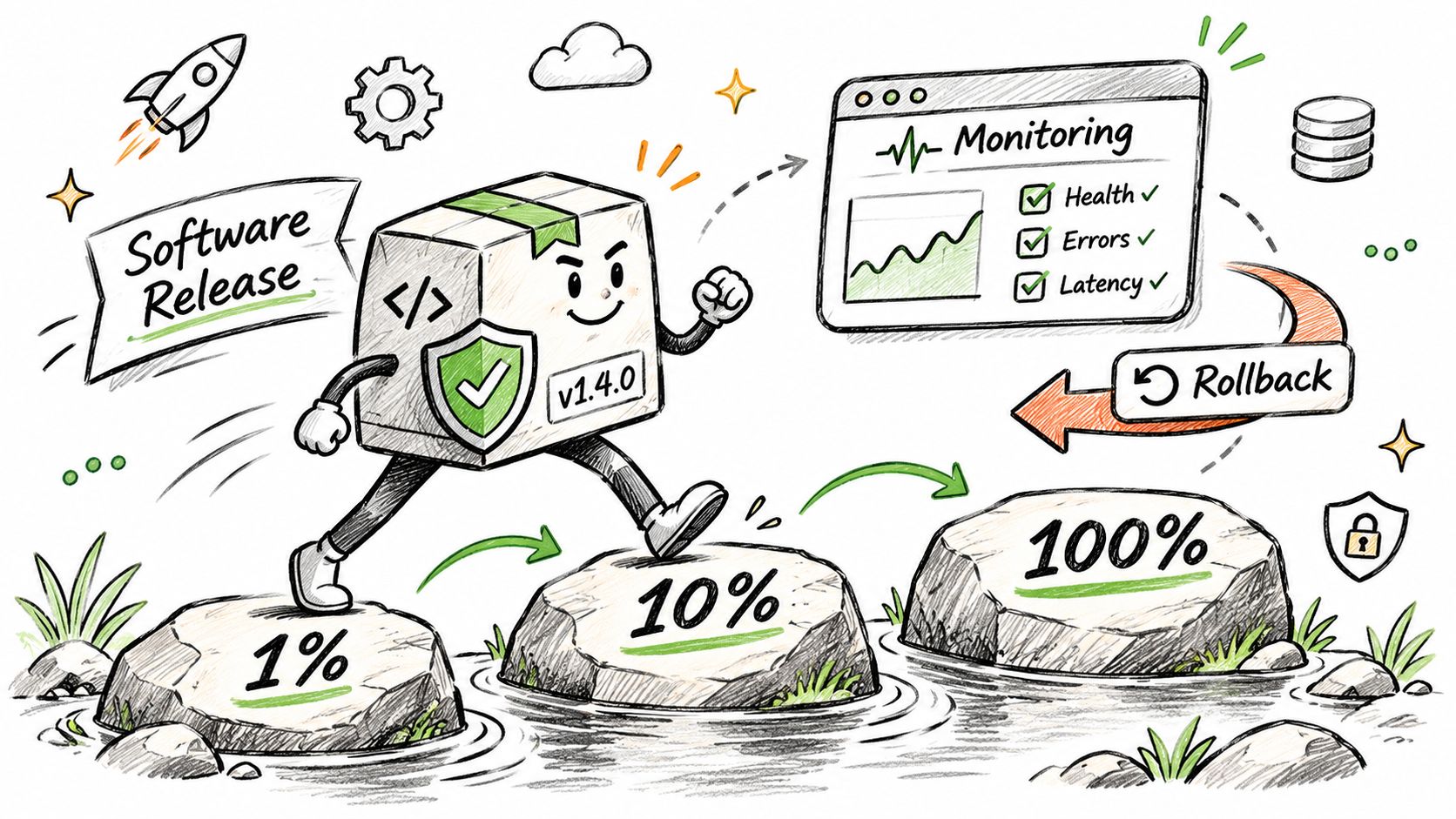
Use feature flags for staged exposure. A proposed rollout might move from 1 percent to 10 percent, then full release, but advancement should depend on observed health rather than elapsed time alone.
Make rollback executable
Write rollback steps as a numbered procedure:
- Stop expansion: Pause the rollout and disable new requests where needed.
- Contain work: Drain, pause, or cancel queued jobs using the approved runbook.
- Revert safely: Restore compatible application behavior without assuming data changes are reversible.
- Verify recovery: Check user outcomes, queue health, errors, and data consistency before reopening access.
Name an owner for every alert. Define useful metrics and logs without recording sensitive payloads unnecessarily. For agent activity, an AI agent observability plan should connect findings, fixes, and approval evidence.
The Infosys technical-review model emphasizes test-case alignment, coverage, complexity, and alternatives. Use those dimensions rather than approval speed alone.
The second agent checks implementation conformance before human live review. Use our preview deployments and page-annotation widget to inspect UI behavior. Fix rounds must address the notes and provide evidence that the revised change passes.
How the 8 checklist items compare at a glance
| Item | Key Output | Typical Reviewer | Top Pitfall |
|---|---|---|---|
| Problem Statement and Goals | Problem, affected users, and measurable success criteria | Product and engineering reviewers | Vague goals make the design hard to evaluate |
| Scope and Non-Goals | In-scope work, exclusions, and deferred items | Stakeholders and engineering reviewers | Scope creep when exclusions are unclear or untracked |
| Architecture and Component Overview | System diagram and summary of components and interactions | Architects and engineering teams | Diagrams become outdated or overly detailed |
| Data Model and Storage | Schema, storage choices, migrations, and retention rules | Database and data engineers | Risky changes after launch |
| APIs and Interfaces | Interface contracts, examples, errors, and versioning rules | API consumers and frontend/backend engineers | Poor naming or breaking changes affect dependent clients |
| Security and Privacy Review | Threats, access controls, secret handling, and data practices | Security, privacy, and compliance reviewers | Threat assessments become outdated |
| Scalability, Performance, and Reliability | Load estimates, performance targets, and failure plans | SRE and infrastructure engineers | Over-engineering for unlikely loads |
| Testing, Observability, and Rollout Plan | Test strategy, monitoring, staged release, and rollback steps | QA, SRE, and release owners | Excessive metrics create noise |
Make the Checklist Part of Every Design Cycle
Run the technical design review checklist in order, from the problem statement through rollout. Don't wait until the document is polished to discover that nobody owns the data or accepts the recovery plan. Early questions are cheaper to resolve than decisions embedded across code, tests, and deployment scripts.
Assign a reviewer role to every item. The product owner handles intent, the technical lead handles scope and architecture, and the relevant data, security, interface, and operations owners handle their risks. A small team can combine roles, but it shouldn't leave responsibilities unnamed.
Record findings that someone can close
Keep open questions on the card, beside the design and implementation evidence. Give each finding a type, severity, owner, status, and closure condition. Distinguish defects, risks, decisions, and evidence gaps so a missing benchmark doesn't get treated like a wording suggestion.
- Defect: Something contradicts a requirement or approved contract.
- Risk: A known failure or limitation needs mitigation or explicit acceptance.
- Decision: An accountable human must choose between alternatives.
- Evidence gap: A claim needs a test, diagram, trace, or rehearsal result.
Formal inspection offers a useful foundation. The software inspection guidance describing Fagan's process separates preparation, inspection, rework, and follow-up. Keep that separation even when agents perform much of the work: finding a problem, changing the artifact, and verifying the correction are different tasks.
In Loupe, a clean design with no open questions can approve itself when published and move the card forward, subject to the workflow template. That makes closure rules important. Configure human checkpoints for decisions that need accountable judgment, and don't erase unresolved questions merely to obtain a clean state.
Verify the answer, not just the edit
Our fix rounds record answers to review findings, and the next agent review checks the evidence. The human reviewer should still inspect high-impact decisions and confirm that the revised design preserves the original intent.
Track fix rounds, hours to merge, and cost per finished card alongside review outcomes. A fast approval isn't useful if the team later discovers an unsafe migration or an unowned alert. Keep the checklist brief enough to use, specific enough to challenge, and connected to the work all the way through release.
Loupe connects technical design, agent review, implementation, and human live review on a shared board. Visit Loupe to explore a workflow where review findings lead to traceable fix rounds before changes reach final approval.