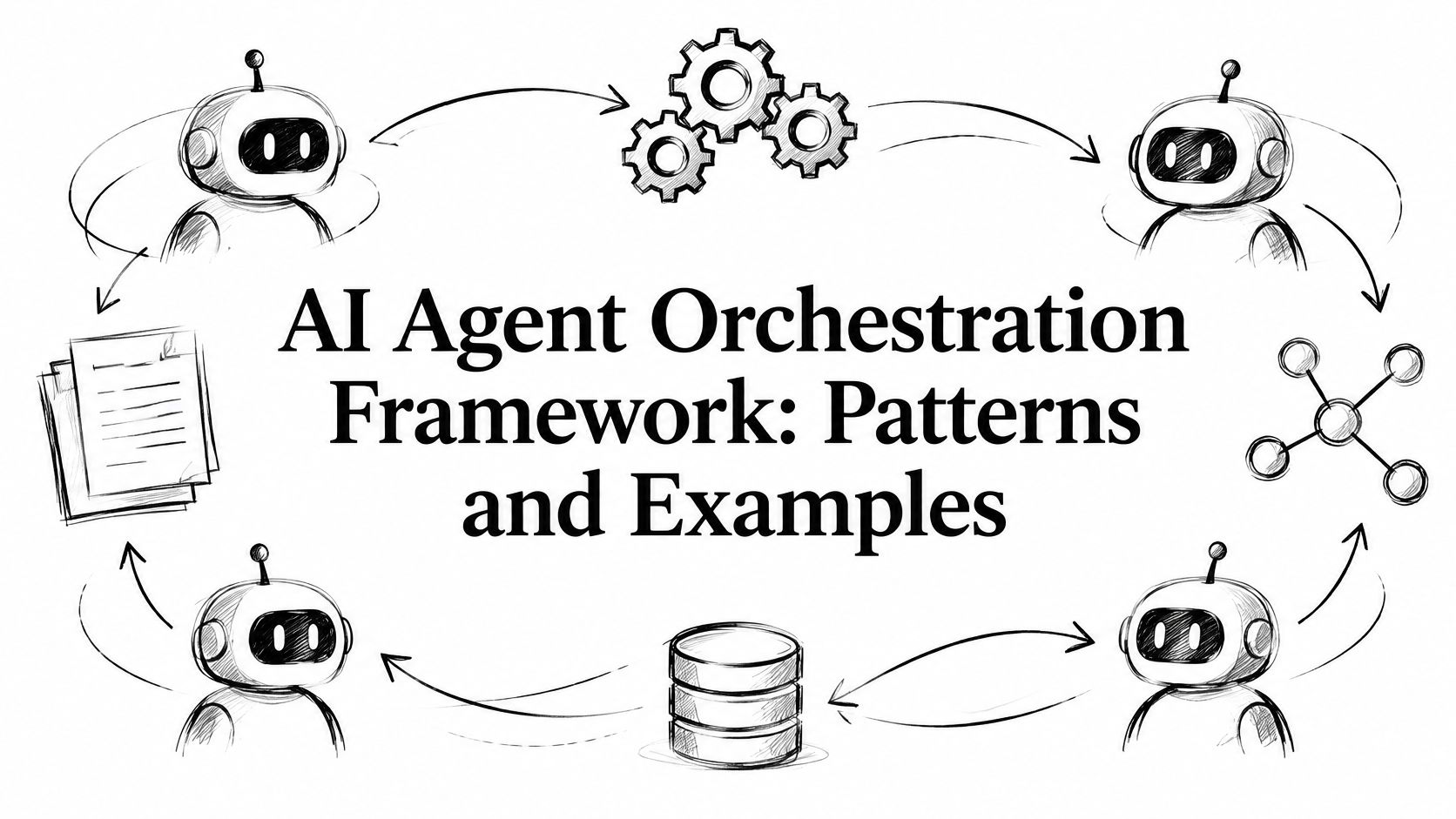
AI Agent Orchestration Framework: Patterns and Examples
Learn what an AI agent orchestration framework does, how the main architecture patterns differ, and how to choose one for your team.
In this article
- What an AI Agent Orchestration Framework Does
- Architecture Patterns and When Each Fits
- The Building Blocks Every Framework Shares
- A handoff that drops a requirement
- How Work Moves Through a Pipeline Step by Step
- Where Human Checkpoints Belong
- Three checkpoints that earn their wait
- Measuring Whether Your Framework Works
- A fair comparison
- Pick a Framework and Run a Pilot
Who decides the run should stop when a plan is wrong, or when two agents edit the same file?
An AI agent orchestration framework is the software layer that plans work, assigns it to agents, tracks state, and chooses when to continue, retry, or stop. A stronger model still answers one prompt. It does not keep a shared record, pass work to the next agent, or wait for a person.
That wait is a governance choice, not only a routing choice. Checkpoints say whether a handoff may proceed. Later measurement shows whether those stops caught bad work. Agent tooling in practice is still new, so those rules carry as much weight as the model.
What an AI Agent Orchestration Framework Does
Think of a conductor. Each musician can play well alone. The conductor sets the tempo, cues each section, and stops the piece when something goes wrong. An AI agent orchestration framework does that job for software work.
A lone model answers one prompt. A working agent also needs tools, memory, retries, and checks. The orchestration layer supplies those pieces and decides the next move.
Deployed agents usually sit on three layers. The 2025 AI Agent Index describes that chain: foundation models supply reasoning, orchestration platforms supply scaffolding and coordination, and agent builders connect the result to users. The same index found that 24 of 30 documented agents were released or received major agentic feature updates during 2024–2025. Most of those agents rely on frontier-company models and add an orchestration layer above them. Standards, identity, and security are still forming. They are not settled infrastructure.
Say a team asks for a login page. A design agent writes the screen. A build agent changes the code on a branch. A review agent checks the diff against the approved design. A person approves the result before it merges. Without orchestration, someone copies each result by hand into the next chat. Context drops out. Nobody can see which step is waiting.
Use a three-question test before you add a framework.
- More than one step: Design, build, and review are separate jobs.
- More than one actor: Different agents or tools touch the same change.
- A person must approve: A wrong guess would be expensive to undo.
If you answer yes to any of them, the layer is worth the setup. It turns model skill into a repeatable workflow, splits tasks, and leaves checkpoints for review.
Architecture Patterns and When Each Fits
| Pattern | Best for | Main risk | Warning sign |
|---|---|---|---|
| Single controller | Small tasks with one planner | Controller becomes a bottleneck | Long queues before each step |
| Sequential pipeline | Work with fixed stages, such as design, build, review | Slow end to end | Stages wait on each other for no clear reason |
| Parallel fan-out | Independent parts of one change | Merge conflicts and duplicated work | Two agents edit the same file |
| State graph | Work that loops until a check passes | Hard to test every path | Cards cycle between the same two stages |
| Peer handoff | Flexible, open-ended tasks | Hard to trace who decided what | Missing context after a handoff |
Single controller. One lead agent plans the work and calls workers in turn. Debugging is simple because one log holds the plan. The lead becomes a queue when every step must wait for it.
Sequential pipeline. Stages run in a fixed order, such as design, then build, then review. Audits are easy because the path never changes. The cost is clock time. A late design comment blocks code that could have waited.
Parallel fan-out. Several agents take independent parts at once, then a merge step combines them. It is faster only when the split is clean. If two agents edit the same file, you pay the time back in conflicts.
State graph. Stages are nodes. Conditions pick the next node, so a failed review sends the card back to build. Loops fit this shape. Drawing and testing every path takes real effort.
Peer handoff. Agents pass control to each other with no central planner. That flexibility helps open-ended research. It is the hardest pattern to trace when a later agent is missing context.
Practical rule: Start with a sequential pipeline that includes a review step. Add parallel work only when the stages are truly independent.
Most real systems mix two patterns. A pipeline can keep design, build, and review in order, while the build stage fans out to agents that own separate files. Code-first graphs give you that mix with more setup. A hosted board can do it with less drawing, and less room to change the edges. Pick the mix you can explain to a new teammate in one minute.
The Building Blocks Every Framework Shares
Every serious framework shares five parts. Miss one, and extra agents make the mess larger.
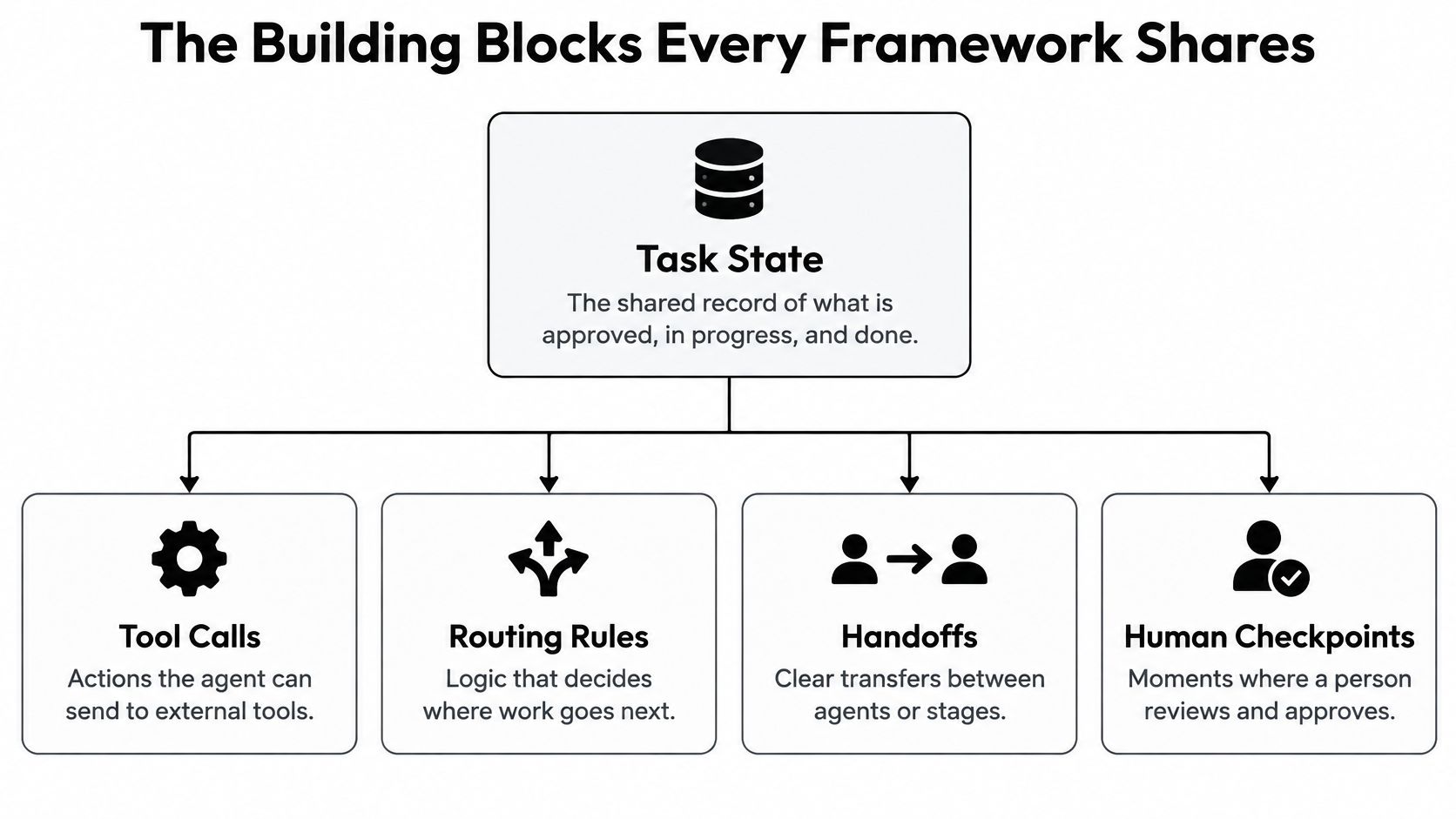
Task state is the shared record of what is approved, in progress, and blocked. If that record lives only in an old chat, the next agent invents the missing lines.
Tool calls are actions such as reading a file or opening a pull request. Each call needs checked inputs. A bad path or a stale branch becomes a real change, not a typo in prose.
Routing rules decide which agent or stage gets the next task. Write them down. If you leave the choice to the model, two runs of the same card can take different paths.
Handoffs carry a compact contract, not a transcript. Include the approved requirements, the design version, the acceptance tests, the files in scope, the open risks, and the evidence from earlier agents.
Human checkpoints sit where a wrong guess is costly. A person should see the design before code starts, and the diff before it merges.
A deterministic simulation benchmark evaluates plans with a task graph, per-agent context limits, an agent budget, and how completely information is transferred. Its central finding is that extra agents can ease context pressure, then hit diminishing returns and coordination failures when state is fragmented or passed on incompletely.
A handoff that drops a requirement
Bad path: a build agent gets "add the feature" in chat, misses one requirement, and a review agent passes code that does not match the design. Fix: store the contract in shared workflow state. The coding agent, the review agent, and the human all read the same source of truth.
Watch for information loss, not only speed. Missing requirements in a plan, review findings that never show up in the revision, and repeated clarification requests are the early signs. Pair them with merge rate, fix rounds, cost per card, and hours to merge.
Before you adopt a framework, write down three answers: where state is stored, what a handoff must include, and who can stop a run.
How Work Moves Through a Pipeline Step by Step
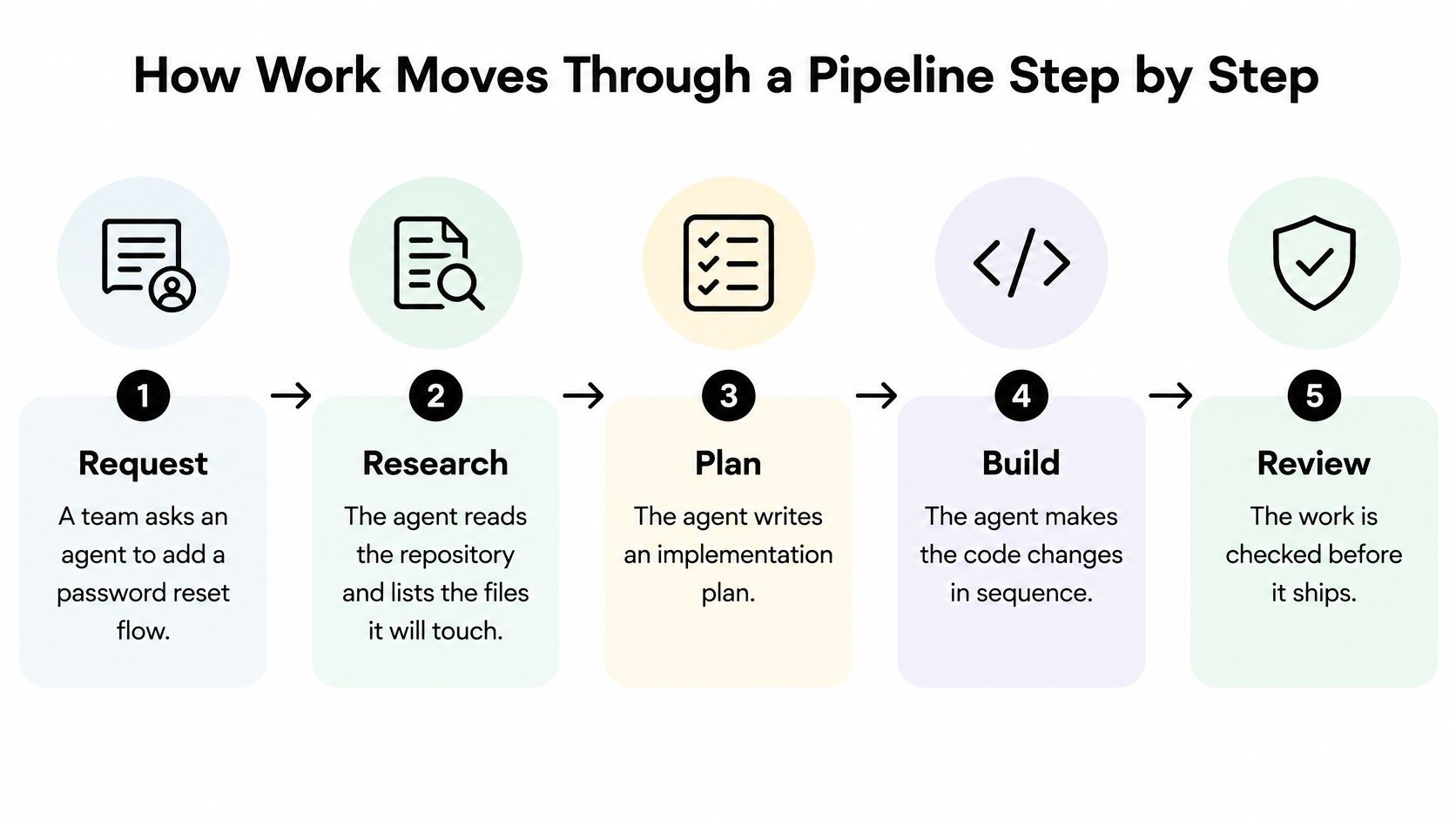
A password reset looks small. It still breaks when the next stage has to guess. Work moves like a traveler card on a factory line. Each station stamps what it finished. The next station holds the card if a stamp is missing. Routing picks a worker. A checkpoint decides whether the work may continue.
- Research. The agent reads the repository and lists the files it will touch. That list stops a later edit in a forgotten helper. The slip is a file list that names folders, not the functions that must change.
- Plan. The agent writes an implementation plan and stores it as a document. A stored plan can be reviewed. A plan that stays in chat cannot. The slip is a plan with no acceptance tests.
- Plan review. A person reads the plan, comments, and approves it or sends it back. Skip this and the build agent fills in the requirements. The slip is a rubber-stamp approval with no comments.
- Build. The agent makes changes on a separate branch and records build notes. The branch keeps main safe. The slip is a commit with no note of what was left unfinished.
- Agent review. A second agent checks the change against the approved plan and returns findings. Implementation and review stay separate jobs. The slip is a review that only says "looks good."
- Fix round. The build agent answers each finding with evidence, and the review runs again. Evidence shows the finding was met, not waved off. The slip is a rewrite that ignores one comment.
- Pull request. The change opens only when someone asks for it. Documented agent workflows often follow the same rule: the agent researches, refines a plan, changes a branch, and does not open a pull request unless requested. If that request is skipped, nobody has agreed to read the diff before it can land.
- Merge. A person inspects the diff and merges it. The agent does not get the last word. The slip is merging because the checks are green while the design is still wrong.
More examples of AI agents in software work show the same pause between a branch and a merge. A healthy run waits at a named gate. Every stage leaves a stored output the next stage can read.
Where Human Checkpoints Belong
Keep each agent run short, and place a checkpoint at the end of each stage. Agents do well on tight tasks. They weaken when the run stays open for a long time.
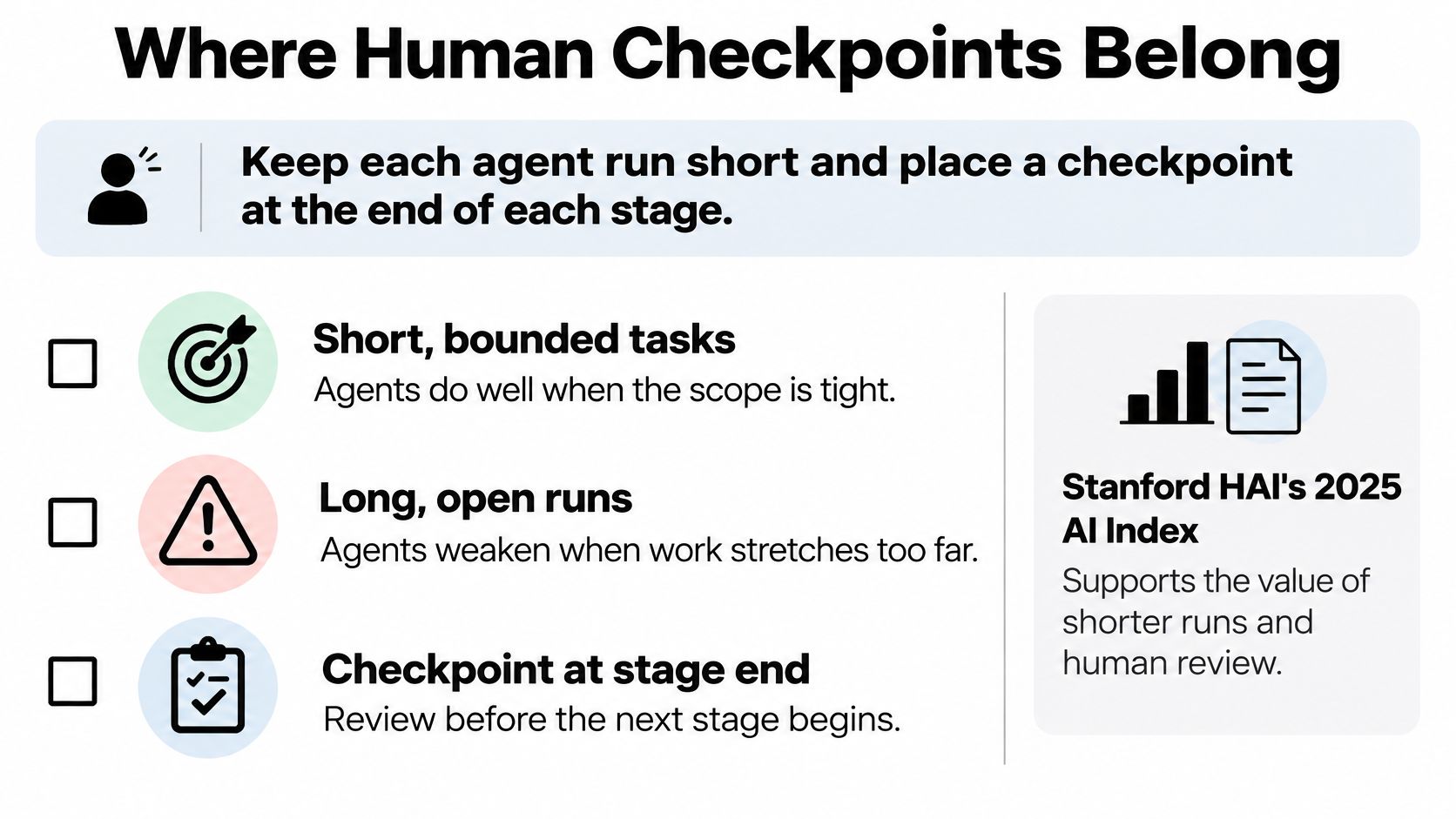
Stanford HAI's 2025 AI Index reported RE-Bench results on complex tasks. Within a two-hour budget, top AI systems scored four times higher than human experts. When working time rose to 32 hours, humans outperformed AI by a 2-to-1 margin. Short bursts favor the model. Long autonomous runs expose weak planning, poor error recovery, and lost context.
Three checkpoints that earn their wait
Approval before an expensive stage. A person signs the design before any code is written. A wrong screen is cheap to fix on paper and costly in a branch.
Review of agent output before it moves on. The next stage reads an approved artifact, not a draft. A draft document should show whether an agent is still reviewing it. Publish now and Finish review should ask for confirmation before that agent review stops, so a click does not kill a check that is still running.
A stop rule after repeated failures. If a card fails a set number of fix rounds, it waits for a person. Another automatic loop rarely fixes a vague requirement.
Write the rules as conditions. A card needs a person when the agent asks a question, when checks fail, or when the change is ready to merge. Split software delivery into design, implementation, testing, and review. Do not run one unconstrained coding session and call it a pipeline. Deeper notes on human-in-the-loop agent reviews cover how those pauses are staffed.
More checkpoints mean more waiting. Place them only where a wrong step is expensive.
Before the first real card, write four lines: who approves each stage, what happens after two failed reviews, which actions an agent may take alone, and where the audit record is kept.
Measuring Whether Your Framework Works
Judge a framework on more than a correct final answer. A cheaper model that needs repeated repair can cost more in time and money than a stronger model with fewer steps.
| Metric | What it shows | Warning sign |
|---|---|---|
| End-to-end success | Share of runs that reach the goal without help | Drops after a model or prompt change |
| Tool-call validity | Share of tool calls with correct arguments | Rising errors after a tool schema change |
| Retry count per stage | How often a stage has to repeat | Many retries mean unclear instructions |
| Latency per stage | Time each stage takes | One slow stage hides the real cost |
| Token cost per accepted result | Spend for each finished, approved change | Cheap calls with many repairs cost more overall |
| Recoverability | Whether a failed run resumes without a restart | Restarts that lose earlier work |
| Fix rounds per change | Review loops before approval | High counts mean vague requirements |
Recent orchestration research models the controller as choosing among answering, retrieving, calling a tool, verifying, or stopping. It should not let an agent call tools forever. Each extra call can add a bad argument, stale state, duplicated work, or a wrong assumption. Record end-to-end success, tool-call validity, latency, token cost, retry count, and recoverability. A correct pull request that took six repair loops is not a cheap win.
A fair comparison
Use the same task set every time. Freeze the prompts and the tool versions. Compare cost per accepted result, not cost per call. Run at least a few real cards through each option before you decide. Demo tasks rarely show retry loops or a handoff that drops a requirement.
Stage-level numbers also show where the framework only adds steps. If latency sits in human wait, the model is not the bottleneck. If retries spike after a schema change, the tool contract is. Teams that want how to watch agent runs should log these seven measures on every card, then keep the option with fewer repairs, not the one with the lowest price per token.
Pick a Framework and Run a Pilot
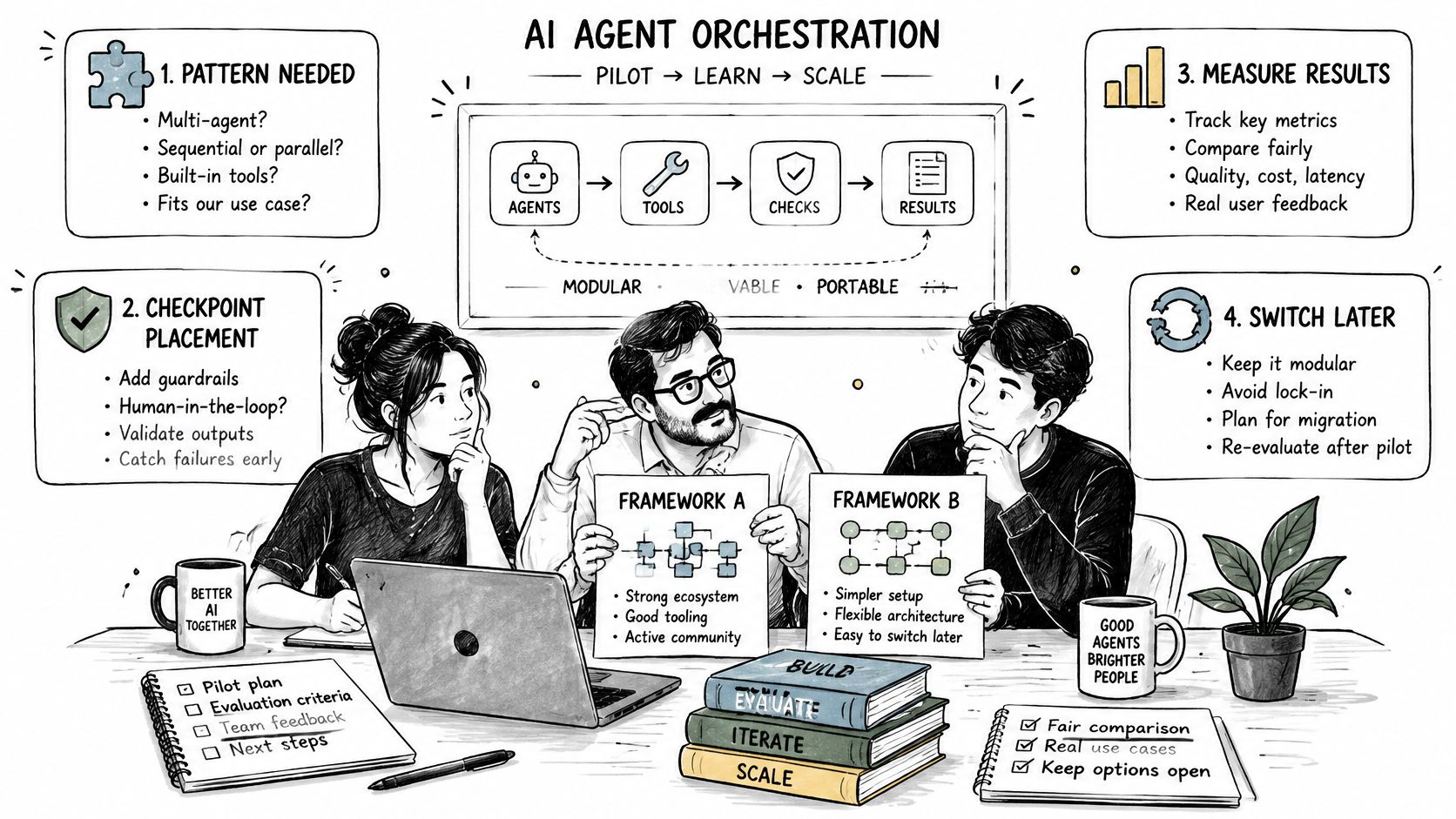
Choose with four checks, in this order. First, the pattern your work needs. Second, where the checkpoints sit. Third, how you will measure results. Fourth, how hard it is to switch models or tools later.
Code-first frameworks give you more control over graphs, retries, and state. They also take more setup and more tests. Hosted platforms start faster. They may limit the edges you can change, and they may hold run history you would rather keep yourself. Neither is free. Control costs engineering time. Speed costs flexibility.
Loupe is one option built for this handoff problem. It is a software factory for coding agents that runs on your own terms, with your agents, your machine, and your rules. Cards move across product design, tech design, implementation, agent review, live review, and done. Work pauses at checkpoints marked for you. You can self-host it under the AGPL with Docker Compose, or use the hosted service in private beta.
Run the readiness check before the pilot. The project needs a connected agent, a ready bridge, and the agent account that pushes code. Use a second GitHub account for the agents so a person can approve their pull requests.
Then keep the pilot small.
- One feature: Pick a change you could review in an afternoon.
- One card: Run it from design to merge, with a person at each checkpoint.
- The same measures: Record success, retries, token cost per accepted result, and fix rounds.
- A baseline: Compare that card with how your team ships the same size of change today.
The best framework is the one whose checkpoints match your riskiest step. If design mistakes hurt most, stop there. If bad merges hurt most, stop before the pull request lands.
Loupe gives coding agents a single board for product design, technical design, implementation, and review, with pauses where a person must approve the handoff. If you want that control on your own machine and your own rules, start with one small card and see where the checkpoints catch a bad plan. Visit Loupe to run the pilot on your repository.