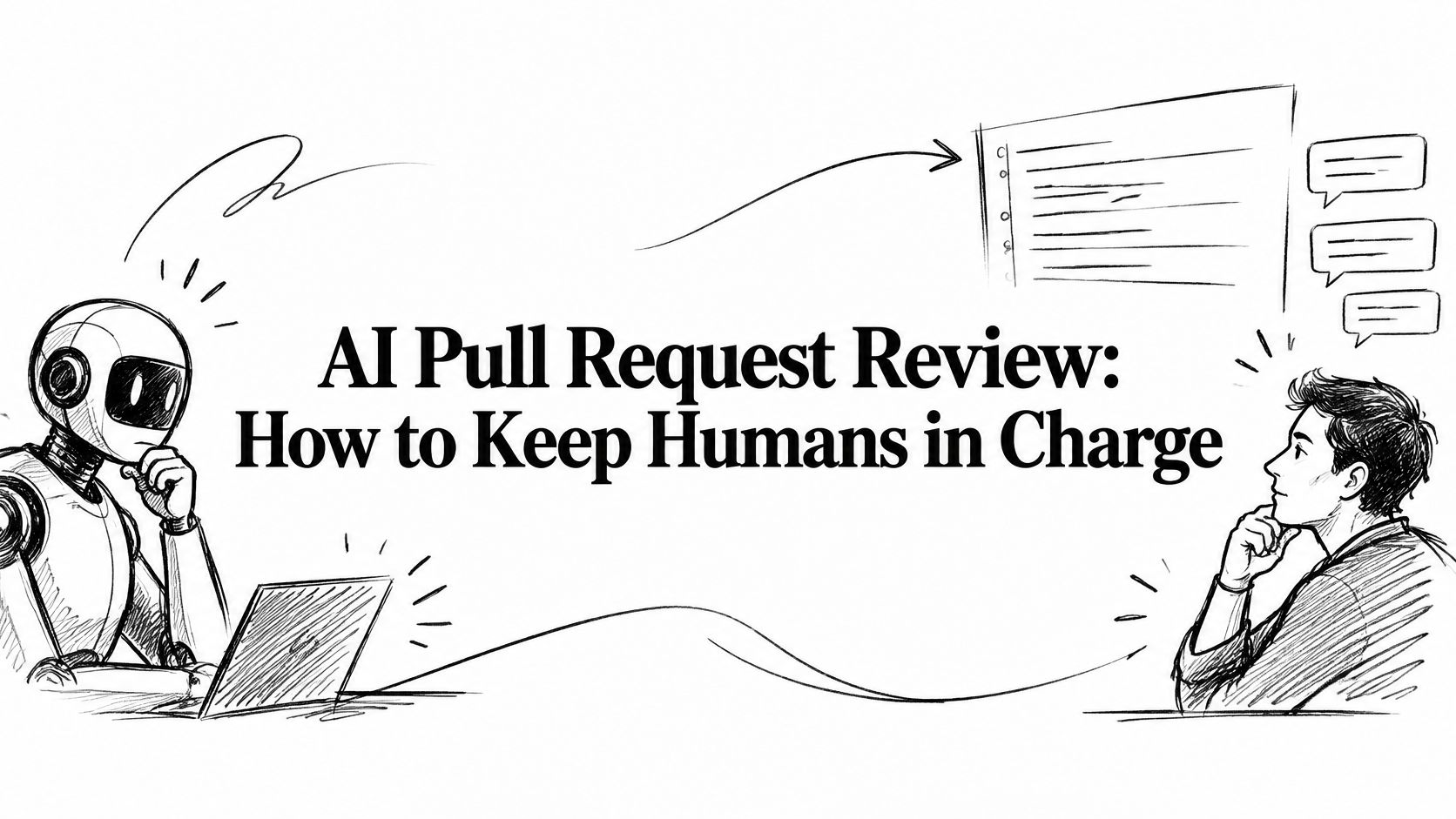
AI Pull Request Review: How to Keep Humans in Charge
Learn how to set up AI pull request review in stages, with human checkpoints, useful metrics and fixes for common problems.
In this article
- Where AI Helps and Where Humans Must Decide
- Keep decisions with an owner
- What to Give the AI Reviewer for Better Findings
- Require a finding someone can check
- Make abstention acceptable
- How to Build a Staged AI Review Workflow
- Remove noise before publication
- Separate the builder from the reviewer
- Keep Humans at the Checkpoints That Matter
- Put sign-off at meaningful boundaries
- Protect approval after the review
- Measure Whether AI Review Actually Helps
- Compare against your own baseline
- Common Problems and How to Fix Them
- Fix the publishing rules first
- Start Small and Confirm Your First Checkpoint
- Make the first decision visible
Your pull request is ready, the checks are green, and the AI reviewer has left a long list of comments. Now someone has to sort real bugs from naming suggestions before the change can ship. You've added automation, but you may have added another queue.
AI pull request review should reduce the work needed to reach a sound decision. That means verified findings, clear human checkpoints, and close attention to hours to merge. More comments aren't a win if developers spend longer proving them wrong.
Where AI Helps and Where Humans Must Decide
Let AI make the first pass on a pull request, and let a person make the final call.
Review tasks split between AI and people
| Review task | AI handles it | Human keeps it |
|---|---|---|
| Scan changed code for functional bugs | Flags likely defects with evidence | Confirms the defect matters |
| Check the diff against the approved design | Finds design drift | Decides if the drift is acceptable |
| Spot security-sensitive changes | Flags possible risks | Confirms the risk and picks the fix |
| Clean up style and formatting | Skips or suppresses comments | Left to linters and team rules |
| Weigh trade-offs and project priorities | Lists options only | Makes the call |
| Approve the merge | Never approves alone | Approves the pull request |
The split is between pointing and deciding. AI can point to an unchecked return value, a changed permission boundary, or an implementation that doesn't match the design. A person decides whether the behavior is wrong and what should happen next.
Style belongs outside that conversation. Let tools such as ESLint, Prettier, or your formatter enforce rules mechanically. Don't spend human attention judging an AI's preference for a different variable name.
Keep decisions with an owner
Say a payment change lacks retry handling. The AI identifies the failure path and suggests retrying inside the API handler. The human reviewer confirms the risk but puts the retry in the queue worker, where the team manages backoff and duplicate processing.
The finding was useful. The proposed implementation wasn't the final answer.
Practical rule: Give the AI permission to raise an issue, not permission to settle the trade-off.
Write your own task split before enabling automated review. A repository handling payments needs different boundaries from an internal prototype. List your five most common review tasks and mark each AI first pass or human only.
What to Give the AI Reviewer for Better Findings
Give the reviewer the context a careful engineer would request. A diff without intent invites guesses about behavior that may already be deliberate.
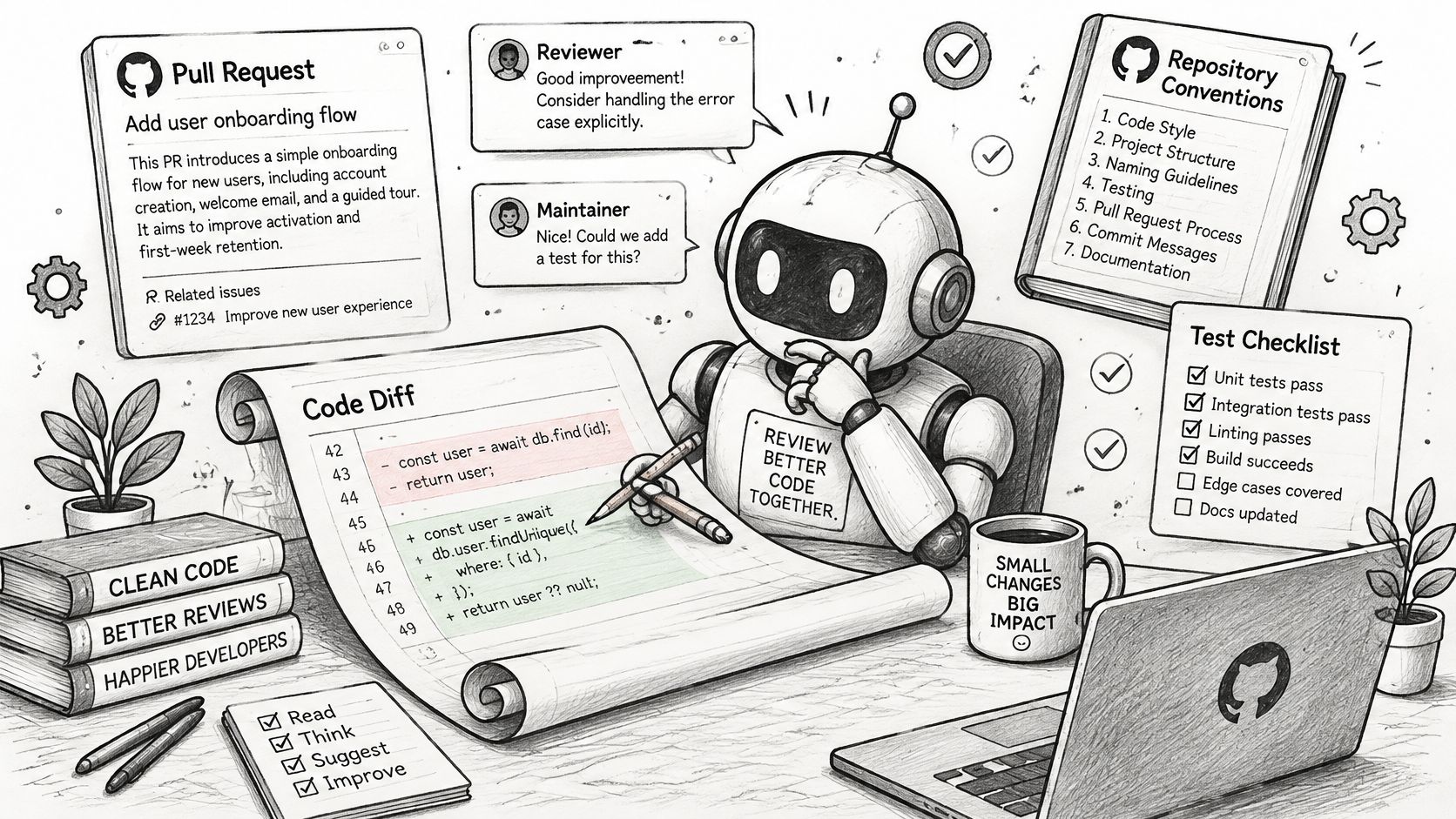
Include the complete diff, pull request description, relevant code comments, repository conventions, and tests or expected behavior. Add the approved technical design and the surrounding callers when a change affects a shared interface.
Require a finding someone can check
Each finding should contain:
- Location: The file and relevant line.
- Severity: The concrete impact, not just a label.
- Broken invariant: What must remain true.
- Evidence: The path, test, or type contract that demonstrates the problem.
- Minimal fix: The smallest change that restores correct behavior.
Consider this hypothetical comparison:
| Weak finding | Strong finding |
|---|---|
| Consider better error handling here. | In account_lookup.py, line 42 returns None for a deleted account, but the caller on line 58 reads an account field without checking. Severity is high because this path fails the request. Return an explicit error result and guard the read. |
The strong version gives a reviewer something to confirm. It doesn't ask them to investigate an undefined concern.
Make abstention acceptable
Tell the model to state what context is missing when it can't decide. For example, it may need the queue's retry policy before claiming a missing retry is a defect.
A code-review evaluation found that adding problem descriptions improved performance, while tested models classified correctness correctly only 68.50% and 63.89% of the time in an evaluation containing 492 examples.
Treat the model as an issue finder, not a judge. Test the setup with a past pull request containing a known bug, and check whether it identifies the right failure at the right location.
How to Build a Staged AI Review Workflow
Don't publish every suspected issue straight to GitHub. Put verification and filtering between generation and publication.
A repository-grounded review benchmark evaluated 1,000 real-world pull requests and found low precision and high false-positive rates in current automated review systems. A plausible comment isn't enough to interrupt a developer.
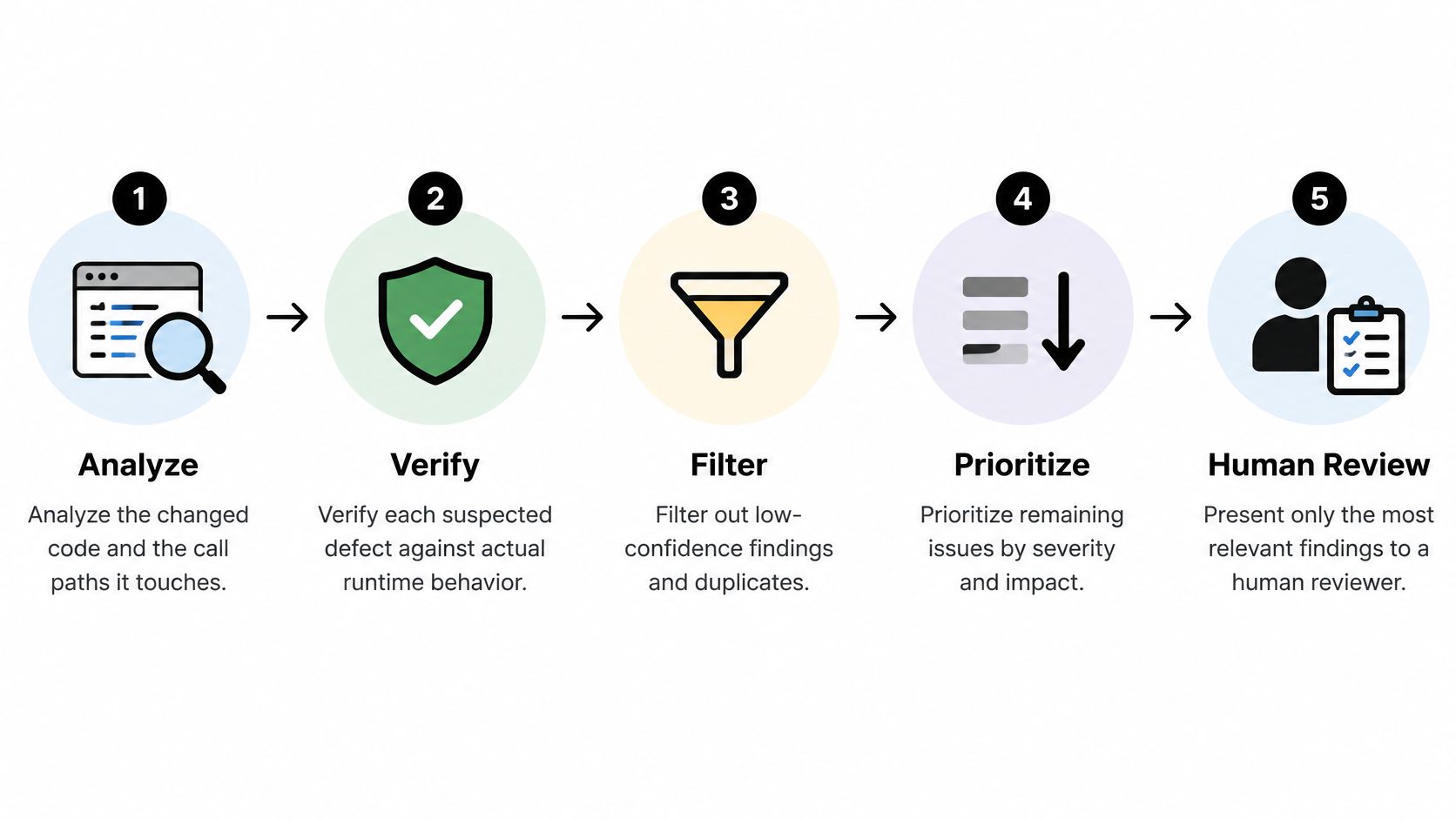
Remove noise before publication
Analyze changed code and affected call paths.
Follow inputs, outputs, and callers across the changed boundary. A local function can look safe while its caller assumes a different return type. Keep the scope tied to behavior the pull request changes, rather than opening a repository-wide cleanup exercise.Verify each suspected defect.
Check tests, types, repository history, and the approved technical design. The most common slip is skipping this step because the explanation sounds convincing. Require a reproducible failure, a clear contract violation, or a traceable execution path. When the evidence doesn't hold, discard the finding.Deduplicate and rank.
Combine findings that describe the same root cause. If security and correctness reviewers both identify the same missing authorization check, post one finding with the strongest evidence. Rank by impact, not by how forcefully the model phrases the warning.Suppress style-only and speculative comments.
Remove preferences that belong in linters. Also remove risks that rely on unsupported assumptions about deployment or usage. Keep those uncertainties in review logs rather than presenting them as defects.Route evidence-backed, high-severity findings to a human checkpoint.
Give the reviewer a short list with enough context to decide. Keep lower-priority observations available without forcing a separate discussion for each.
Separate the builder from the reviewer
In Loupe's implementation stage, a worker builds the approved design and opens a pull request on GitHub. A second agent reviews each design as well as each pull request. That separation provides a distinct review pass, though it doesn't guarantee the agents won't share a blind spot.
Make the handoffs explicit in your pull request workflow: which design version the builder used, what the reviewer checked, and which findings require fixes.
Trust comes from checking suspected defects before posting them, not from writing more confident comments.
A healthy run leaves the person with verified findings, few duplicates, and a list they can finish in one sitting.
Keep Humans at the Checkpoints That Matter
Write down where a person must sign off. Keep approval attached to the actual change being shipped, not merely to an earlier version of the pull request.
An empirical comparison of review outcomes found 45.20% merge rates for code-review-agent-only pull requests versus 68.37% for human-only reviewed pull requests, with abandonment rates of 34.88% and 21.60%, respectively. These are study results, not a forecast for your repository, and they don't establish that reviewer type alone caused the difference.
Put sign-off at meaningful boundaries
- Before implementation: Approve the design, including scope, constraints, and failure behavior.
- Before merge: Validate the implementation, required checks, and unresolved risks.
- On the preview: Try the changed behavior through a live preview link. For interface changes, check error states and permissions as well as the happy path.
The human job is final validation and project decisions. It isn't reading every line of an agent's internal output.
Protect approval after the review
We recommend a second GitHub account for agents to open pull requests, so you can approve them. Pair that account separation with repository rules that require human approval. A separate identity alone doesn't enforce the policy.
Also hold a pull request after conflict resolution. A conflict fix can change code that someone already reviewed. Our merge skill and approval script hold the pull request after conflict resolution when the project sets approvalCoversConflictResolution to false.
Never let the AI approve alone under this workflow. Keep responsibility visible through explicit human-in-the-loop checkpoints, rather than assuming someone will notice a risky change in the feed.
At each checkpoint, ask: What did the reviewer verify, and what might the AI have missed? Record the answer where the next person can find it.
Measure Whether AI Review Actually Helps
A 2024 industrial study covered approximately 238 practitioners across 10 projects and analyzed 4,335 pull requests from three projects: 36.2% received automated review, 73.8% of tool comments were resolved, yet average closure time rose from 5 hours 52 minutes to 8 hours 20 minutes, approximately 42% longer.
That's the trade-off to watch. Developers can act on comments while spending longer closing pull requests. Resolution alone doesn't prove better quality or faster delivery.
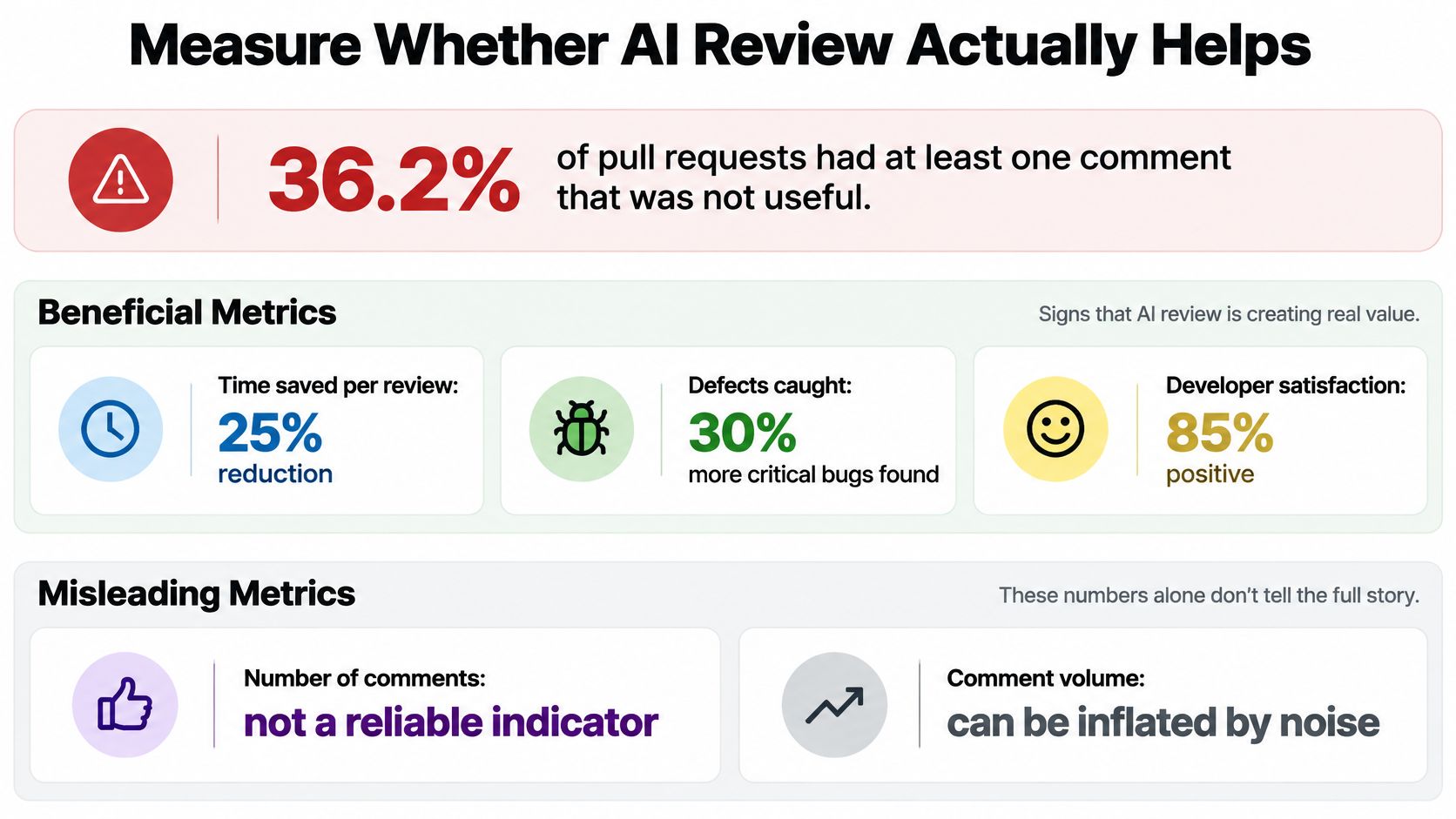
Treat the graphic as a visual overview, not benchmark evidence. Its usefulness warning and performance percentages aren't supported by the industrial study; use the study results above and your own measurements instead.
Metrics to track for AI pull request review
| Metric | What it tells you | Healthy sign |
|---|---|---|
| Comment resolution rate | Share of AI comments that developers act on | Rising over time |
| Actionable finding precision | Share of AI findings a reviewer would ask to change | High and steady |
| False-positive rate | Share of AI findings rejected as wrong | Low and falling |
| Fix rounds per card | Rework needed after review | Fewer rounds over time |
| Hours to merge | Time from opening a pull request to merge | Flat or falling |
| Merge rate | Share of pull requests that get merged | Close to your human-only baseline |
| Revert rate after merge | Changes rolled back later | Same or lower than baseline |
Compare against your own baseline
Measure for two to four weeks before enabling AI review as a practical starting window. Keep definitions stable, and separate results by repository and change type so a batch of simple fixes doesn't hide slower feature reviews.
Read the table in order. Resolution measures response, while actionable precision asks whether a competent reviewer would request a change. Track rejected findings separately, and don't count a dismissed thread as a successful fix.
Then inspect fix rounds and hours to merge together. Fewer rounds aren't helpful if each round takes longer. Finally, compare merge and revert rates with the human-only baseline so faster shipping doesn't conceal more rollbacks.
Loupe's analytics show cost per finished card, merge rate, fix rounds, and hours to merge, and let you compare models with experiments. Use AI agent observability to connect review behavior to delivery outcomes.
Start with three metrics, not ten, and review them monthly with unchanged definitions.
Common Problems and How to Fix Them
Too many comments on a small pull request is the first problem to fix. Don't ask developers to become better at ignoring the tool. Change what the tool publishes.
Common AI review problems, causes and fixes
| Symptom | Likely cause | Fix |
|---|---|---|
| Too many comments on small pull requests | Style and speculative findings are not filtered | Suppress style-only and speculative items |
| Developers ignore most comments | Findings have no evidence or location | Require file, line, evidence and fix in every finding |
| Reviews slow down merges | Noisy findings add extra discussion | Send only verified, high-severity findings to humans |
| The same issue is flagged twice | No deduplication step | Deduplicate and rank before posting |
| Risky change gets approved | AI is acting as the approver | Keep a human approval rule before merge |
| Design drift is missed | Approved design is not in the review input | Add the approved design to every review |
Fix the publishing rules first
Filters and evidence requirements are usually the cheapest changes to attempt. Plan to edit the rules in a day, then inspect results during the sprint. That's a rollout plan, not a promised time to improvement.
Changing stage ownership or rebuilding trust takes longer. Allow a few weeks of consistent behavior before asking developers to rely on the reviewer again. Keep a small sample of accepted and rejected findings so you can distinguish better detection from more aggressive filtering.
Consider a hypothetical example: a team receives 30 comments on a 40-line change, mostly about naming. After suppressing style-only findings, the list falls to four, and human review confirms two real bugs. The improvement isn't the shorter list alone, it's that reviewers can reach the meaningful findings without sorting through preferences.
Stop condition: If the reviewer keeps approving risky changes, pause automated approval and inspect the merge rules.
Don't solve that failure by making the prompt sound stricter. Check permissions, required reviewers, and whether the latest commit still needs human approval. A good review prompt can't repair a missing enforcement rule.
Start Small and Confirm Your First Checkpoint
Choose a low-risk repository and run AI review in suggest-only mode for two to four weeks. Before the pilot, record hours to merge, fix rounds, and revert rate. Keep a human checkpoint before merge.
At the two-week check, judge the findings and delivery outcomes, not the comment count. Expand only if developers act on verified findings, hours to merge are flat or falling, and safety measures have not worsened. If developers spend too much time checking weak comments, improve the review inputs and evidence rules before expanding.
Make the first decision visible
- Go: Verified findings justify the effort, with no concerning delivery or safety trend.
- Hold: Developers spend time disproving comments, or there is not enough completed work to judge the pilot.
- Stop: Required human approval can be bypassed.
Loupe is one option for managing this process. Its agent review checks each design and pull request against the approved design, sending changes back for fixes before you see them. The board shows where a person must act.
Write the human checkpoint list before the first run. Name who owns each decision and who takes over when that person is unavailable.
Keep agent implementation, design review, fix rounds, and human checkpoints in one workflow with Loupe. Visit Loupe to see how its workflow keeps approved designs visible and tracks fix rounds and hours to merge, rather than comment volume.